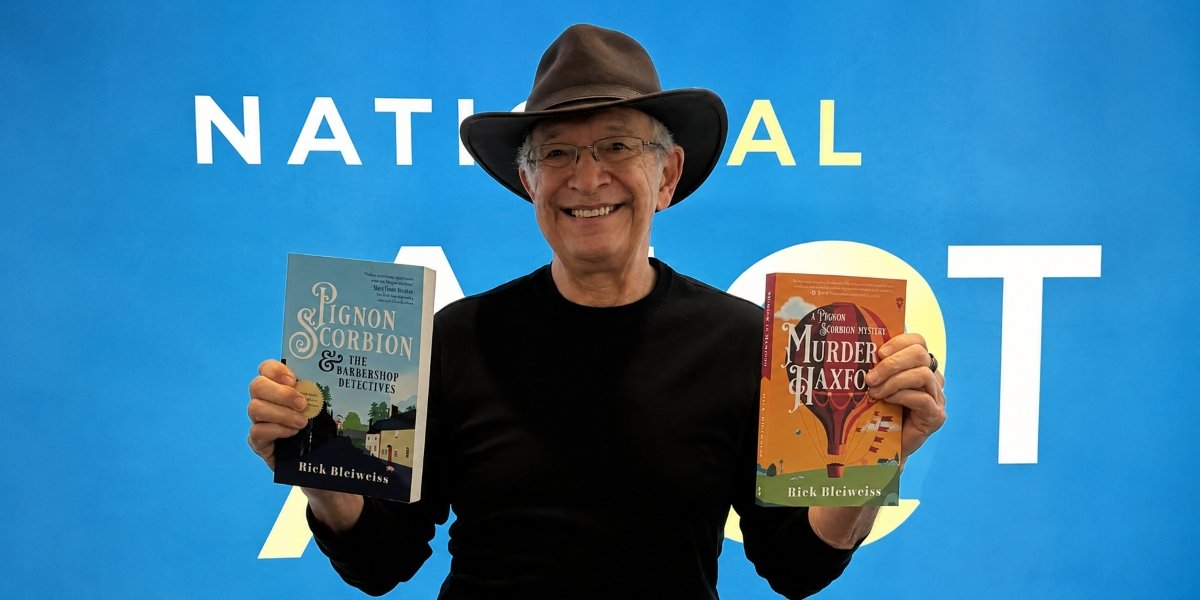

Every memorable detective possesses an unmistakable method. Sherlock Holmes trusts observation. Hercule Poirot relies upon order and psychology. Philip Marlowe follows instinct into places polite society prefers to ignore. Their investigations reveal as much about human nature as they do about crime itself. Rick Bleiweiss approached detective fiction from an altogether different direction.
Before creating Chief Inspector Pignon Scorbion, Rick had spent decades studying another cast of fascinating personalities, musicians, executives, performers, promoters, publishers, journalists, and artists whose ambitions, rivalries, loyalties, and contradictions filled the recording studios, boardrooms, concert halls, and publishing houses of America. Long before he began constructing fictional mysteries, he had observed real ones happen in everyday professional life.
Perhaps that explains why the crimes in his novels never feel like elaborate puzzles assembled merely to surprise readers. They begin with people.
Observation Rather Than Convention
There is an old misconception that mystery writing depends primarily upon clever plotting. The finest mysteries suggest otherwise. They succeed because readers become fascinated by motive before method. Murder matters less than understanding why seemingly ordinary individuals arrive at extraordinary decisions. Rick appears to understand this distinction instinctively.
His Pignon Scorbion novels introduce readers to a chief inspector working in the English market town of Haxford in 1910, accompanied by an unconventional circle of collaborators who gather in a local barbershop to untangle crimes. The premise recalls the classic pleasures of Golden Age detective fiction while allowing personality, not spectacle, to occupy the foreground.
Scorbion himself is neither flamboyant nor emotionally detached. He is observant, composed, quietly eccentric, and deeply attentive to the subtleties of human behavior. These qualities feel earned rather than manufactured.
Influence of a Life Spent Reading People
For much of his professional life, he occupied positions requiring a remarkable ability to assess character. Successful producers recognize talent before audiences do. Publishing executives evaluate manuscripts that may become literary successes years later. Marketing executives anticipate public taste before trends fully emerge. Lecturers learn how different audiences absorb ideas. Columnists spend their careers noticing details others overlook. Across each profession, the central skill remains remarkably similar: understanding people.
Over more than seven decades, he worked alongside artists ranging from Whitney Houston and Melissa Etheridge to U2, Barry Manilow, The Bee Gees, Britney Spears, David Bowie, Alicia Keys, and countless others. Every collaboration demanded careful listening, not only to music but to personalities, ambitions, insecurities, and creative instincts. Such experiences do not automatically produce a novelist. They do, however, cultivate an unusual sensitivity to human complexity.
Why the Setting Matters
The decision to place Pignon Scorbion in rural England in 1910 is itself revealing. Contemporary crime fiction often favors escalating violence, forensic technology, and relentless pacing. Rick instead looks backward to an era when deduction depended less upon scientific equipment than conversation, memory, observation, and patience. The village of Haxford becomes more than scenery.
It functions as a living social organism where everyone knows everyone, or believes they do. Beneath everyday routines lie rivalries, concealed histories, financial pressures, romantic disappointments, and private grievances waiting to emerge. The community itself becomes part of every investigation. This emphasis on relationships reflects an understanding frequently overlooked in contemporary thrillers: crimes rarely occur in isolation. They arise within communities.
Writing After a Lifetime of Listening
There is something quietly significant about the chronology of Bleiweiss’s writing career. He did not publish fiction while attempting to establish himself professionally elsewhere. Instead, he began writing novels after decades spent absorbing stories from nearly every corner of the entertainment world.
By the time Pignon Scorbion & the Barbershop Detectives appeared in 2022, he had already spent years writing columns, essays, magazine articles, anthology contributions, and an award-winning political satire published under a pseudonym. His experience with language had accumulated gradually across journalism, publishing, commentary, and nonfiction before finding its fullest fictional expression.
The result was a debut that attracted considerable attention. The novel earned praise from Kirkus Reviews, appeared among Publishers Weekly‘s notable mystery debuts, became a Barnes & Noble selection, received Amazon Editors’ Pick recognition, won the Pacific Northwest Booksellers Association Buzz Book distinction, and reached the top of Amazon bestseller lists in several mystery categories. Television adaptation rights were later optioned, while the fictional world expanded into an interactive video game. These accomplishments suggest readers recognized something distinctive. Not novelty for its own sake. Experience.
Enduring Appeal of Gentle Intelligence
One of the most striking aspects of Rick’s fiction is its confidence in intelligence over spectacle. The novels trust readers to appreciate conversation, deduction, historical atmosphere, humor, and carefully constructed relationships. They belong to a literary tradition that values curiosity more than chaos and observation more than sensationalism. That approach feels increasingly refreshing.
Modern life often rewards speed, quicker headlines, shorter attention spans, faster entertainment. He offers something different. Mysteries that encourage readers to linger over conversations, examine motives carefully, and appreciate the intricate social fabric surrounding every investigation. Perhaps that philosophy could only emerge from someone whose own career has resisted haste.
Takeaway
After all, Rick Bleiweiss did not spend decades collecting accomplishments simply to arrive at detective fiction. He spent those years collecting people, their voices, contradictions, ambitions, generosity, disappointments, and unexpected acts of kindness. His novels reflect that remarkable archive of human experience.
In the end, Chief Inspector Pignon Scorbion does more than solve murders. He reminds readers that every mystery begins long before the crime itself, with ordinary lives, hidden histories, and the endlessly fascinating complexity of being human.