

By: Sebastian Acosta
Global Real Estate Advisor | ONE Sotheby’s International Realty
New inspection standards, greater financial transparency, and changing lending requirements are giving buyers more to evaluate, and more ways to identify value.
For a Florida condo buyer, the view still matters. So do the location, the floor plan, and the pleasure of having a home near the water.
But the most useful document at a showing may be the one without photographs: the association’s budget.
As buyers prepare for 2027, understanding the finances behind a building has become an essential part of understanding its value. Inspection records, reserve studies, insurance arrangements and planned improvements help explain why two seemingly similar apartments can represent very different purchases.
That additional information can work in a buyer’s favor. A carefully evaluated condominium can still be an attractive investment and an enjoyable place to live. The opportunity lies in matching the purchase price to the building’s condition, its financial obligations, and the buyer’s goals.
A Market That Rewards Preparation
Recent Miami-Dade figures offer some support for buyers seeking negotiating room. In September 2026, existing condominiums had 12.3 months of inventory, according to MIAMI REALTORS® + RWorld, which characterized the segment as a buyer’s market. The median percentage of original asking price received was 94%.
Conditions were also changing: condo inventory was down 7.24% from a year earlier. Buyers had considerable choice, but the supply picture was not standing still. These countywide figures provide context; individual buildings and price ranges can behave differently.
For a prepared buyer, the practical advantage is the ability to compare alternatives carefully. Negotiations can address price, closing timing, and responsibility for known assessments, depending on the seller and the contract.
The strongest opportunity is a property whose total economics make sense.
What Do the 25, 30, 40 and 50-Year Inspections Mean?
These numbers are often used interchangeably in real estate conversations. They should not be.
Florida’s statewide milestone-inspection law generally applies to qualifying residential condominium and cooperative buildings of three or more habitable stories. The initial inspection is generally required at 30 years, followed by inspections every 10 years. A local enforcement agency may require the first inspection at 25 years because of local circumstances, including environmental conditions.
Local recertification programs add another layer.
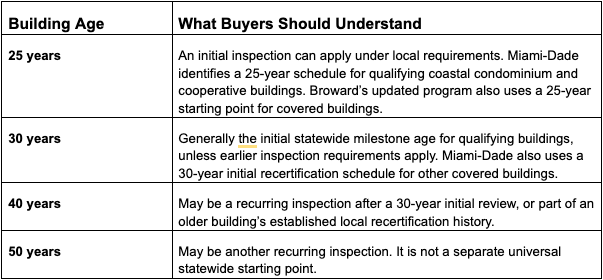
Miami-Dade and Broward guidance shows why an older reference to a “40-year certification” is not enough to establish a building’s current obligations. Buyers should obtain its actual inspection history and confirm the next deadline with the relevant building department.
Age is a starting point for questions. The more revealing information is what inspections found, what work was completed, and what remains planned.
Reserves Are Becoming Part of the Value Conversation
A structural integrity reserve study, commonly called a SIRS, estimates funding needs for specified building components. It is separate from a milestone inspection.
Florida generally requires these studies at least every 10 years for qualifying condominium buildings. Current law restricts the routine waiving of required structural reserves, while allowing certain funding alternatives and conditional temporary pauses.
HB 913, which became law in 2025, added flexibility, including the use of loans and lines of credit under specified conditions. Buyers should therefore examine both reserve balances and association debt. If contributions have been temporarily reduced, ask when they resume and what that means for future payments.
The financial question is broader than how much cash is in an account. Does the association have a credible funding plan, and what will that plan require from this particular unit?
A building that has completed substantial improvements may deserve a different valuation from one still estimating its costs. The documents should establish that distinction.
A Financing Change to Watch in 2027
One important development comes from mortgage underwriting rather than Florida legislation.
Fannie Mae retired its Limited Review process for loan applications dated August 3, 2026 onward. Previously eligible projects must use Full Review or an applicable project-review waiver.
For applications dated January 4, 2027 onward, its standard Full Review reserve-allocation requirement increases from 10% to 15% of annual budgeted assessment income. A qualifying reserve-study alternative remains subject to Fannie Mae’s requirements. These are lending eligibility standards, not a blanket Florida mandate requiring every association to contribute 15%.
Buyers using financing should have their lender review the building early. Cash buyers should also consider financing accessibility when evaluating a future resale audience.
More Information Should Make Comparisons Better
Another recent change concerns access to association records.
Beginning January 1, 2026, associations managing condominiums with at least 25 units, excluding timeshare units, must make specified records available through a website or mobile application. Required materials include budgets, financial reports, certain meeting records, inspection reports, and the latest applicable SIRS. Some information is accessible through protected owner access, so buyers should arrange document delivery through the seller and association.
That makes document organization a useful part of the buying process. Ask for a complete package early enough to review it within the transaction’s deadlines.
Where the Opportunities Can Be
An older building with completed improvements, documented inspections and a workable funding plan may offer compelling value. A newer building may justify a premium through its condition, services, and suitability for the buyer.
Neither age nor a reduced asking price settles the investment question.
For a rental purchase, calculate expected income after association fees, property taxes, insurance, maintenance, management, and vacancy. Then consider financing separately to understand cash flow after debt payments. Confirm rental permissions before relying on projected revenue.
For a primary or seasonal residence, weigh carrying costs alongside the value of personal use and the expected ownership period.
An assessment does not automatically eliminate an opportunity. Its amount, purpose, payment schedule, and contractual allocation need to be reflected in the purchase analysis.
The Right Advisor Should Understand the Numbers

A capable agent should help buyers connect the property search with financial analysis.
That includes comparing completed sales, identifying differences in building obligations, reviewing ownership-cost assumptions, and coordinating early with the lender, attorney, inspector, and insurance professional.
An agent with financial fluency can help a buyer recognize when an attractive price represents value, and when another property offers a better overall fit. Engineering findings and legal conclusions still belong with the appropriate licensed professionals.
Florida condos can remain worthwhile investments for buyers who select carefully, negotiate intelligently, and understand what they are buying. Current conditions provide opportunities worth investigating. Turning one into a successful purchase requires disciplined analysis and strong representation.
The goal is to buy a home you enjoy, at a price you can explain, in a building whose plans you understand.
Connect with Sebastian Acosta
For help comparing Miami condominium opportunities and understanding ownership costs, contact Sebastian Acosta.
Global Real Estate Advisor | ONE Sotheby’s International Realty
Phone / WhatsApp: +1 305-244-6222
Email: sacosta@onesothebysrealty.com
Website: www.sebastianacosta.com
Google Business Profile: Sebastian Acosta, Realtor in Miami
Disclaimer: This article is for informational and educational purposes only and should not be considered financial, investment, legal, or real estate advice. Real estate market conditions, regulations, and lending requirements are subject to change. Readers are encouraged to consult qualified real estate, financial, and legal professionals before making any property purchase or investment decisions.