Many real estate agents now use AI tools to help write blog posts and market updates for their websites. As more agents publish this kind of content, it has become harder for any single agent to stand out as the local expert.
Steve Marcinuk, Co-Founder and CEO of KeyCrew, says the agents who will stand out going forward are the ones with a real point of view, shared in places readers already trust. KeyCrew works with more than 2,000 real estate experts across the country to produce market insights and editorial coverage.
Why Standing Out Is Getting Harder
AI tools have made it easy to publish a steady stream of market content. That is useful for saving time, but it also means many agent websites now cover the same topics in similar ways.
“Publishing more content on your own blog isn’t enough to differentiate yourself in 2026, or certainly 2027,” Marcinuk said.
When readers and AI platforms see similar content everywhere, they look for other signals to decide whose insight is worth paying attention to.
What Agents Are Trying to Achieve
According to Marcinuk, most agents who work with KeyCrew have two main goals. They want local news coverage in the markets they serve, and they want to be visible in AI tools like ChatGPT.
Both goals depend on the same thing: being recognized as a credible voice by sources outside your own website. A blog post shows what an agent has to say. An article in a local newspaper shows that an established outlet found that insight worth sharing with its readers.
What Credibility Looks Like Now
Marcinuk says one of the strongest signals comes from being quoted and published across a range of established local outlets.
“Being an authoritative voice with something real to say, syndicated across a portfolio of local newspapers with real readership, is a really great way to differentiate yourself,” he said. “It highlights the fact that you actually have something worthy to say.”
For agents, this shifts the focus from how much content they publish to what they know about their market that is worth reading. Useful insight usually comes from direct experience: what buyers in a specific neighborhood are asking for, how sellers are adjusting their expectations, or what newcomers to an area want to understand.
A Practical Path to Visibility
Earning coverage in local media has traditionally required time, contacts, and often a public relations budget. Marcinuk says KeyCrew’s model is designed to make that more accessible for individual agents and teams.
“Our model of working closely with market experts to co-produce and distribute well-written content to local newspapers is a great way, at an affordable rate, to support SEO, AI visibility, and thought leadership goals,” he said.
Agents who want to build this kind of visibility can start with a few simple steps:
Identify what you know firsthand. Focus on the patterns you see in your own transactions and client conversations.
Be specific about your market. Local detail is what makes expertise clear to readers.
Look for third-party platforms. Interviews, expert commentary, and syndicated articles add credibility beyond your own website. Agents can apply to be interviewed by KeyCrew to share their market insights.
Let your own voice lead. If you use AI tools to help with your website, make sure the ideas and local knowledge come from your own experience.
The tools available to agents will keep changing. The value of having an informed point of view about your market is likely to hold steady.
KeyCrew is a Florida-based real estate intelligence and media company that owns and operates digital publications covering the real estate industry. Its expert-sourced reporting is syndicated across more than 1,000 publications, news sites, and media outlets.
This article is based on information provided by the expert source cited above. It is intended for general informational purposes only and does not constitute legal, financial, or real estate advice. Readers should conduct their own research and consult qualified professionals before making any real estate or financial decisions.
Initial jobless claims fell 6,000 to a seasonally adjusted 194,000 for the week ending October 17, the Department of Labor reported October 22, beating the 200,000 forecast and landing near the lowest level since 1969. Continuing claims rose to 1.728 million, pointing to a labor market where layoffs are rare but hiring is slow.
Key Takeaways
The prior week’s initial claims were revised up to 200,000 from 199,000, and the four-week moving average fell 1,000 to 197,750.
Initial claims were 231,000 in the same week a year earlier, a year-over-year decline of 37,000.
Unadjusted initial claims totaled 172,390, down 19,321, or 10.1%, from the previous week.
The 189,000 reading for the week of July 18 was the lowest since September 1969, and claims have averaged 212,000 over the past year.
Continuing claims rose 25,000 to 1.728 million for the week ended October 10.
The claims data covered the survey week for October payrolls, which BLS will publish November 6 at 8:30 a.m. ET.
Jobless Claims Hold Near Their Lowest Level Since 1969
The October 22 report extends a stretch of historically low layoffs. At 194,000, initial jobless claims sit just above the 189,000 recorded for the week of July 18, which was the lowest reading since September 1969. Over the past year, initial claims have averaged 212,000, so the latest figure runs well below the 12-month norm.
The four-week moving average, which smooths out weekly swings, eased to 197,750. Compared with the same week in 2025, when claims stood at 231,000, employers are filing far fewer layoff-driven claims. Without seasonal adjustment, initial claims dropped 10.1% week over week to 172,390.
Continuing Claims Rise as Hiring Stays Slow
The other half of the report points in a different direction. Continuing claims, which count people receiving benefits after their first week of aid, rose 25,000 to a seasonally adjusted 1.728 million for the week ended October 10. Continuing claims are reported with a one-week lag behind initial claims.
Rising continuing claims alongside falling initial claims is the signature of a low-hire, low-fire labor market. Employers are holding onto the workers they have, but people who do lose jobs are taking longer to land new ones. Payroll data backs that reading, with payrolls rising just 29,000 in September while the unemployment rate held at 4.2%.
What the Low-Hire, Low-Fire Labor Market Means for Small Business Owners
For employers, the data describes two markets at once. Retention is strong across the economy, which means competitors are also keeping their staff and experienced workers are less likely to be on the market. At the same time, the people who are looking for work are staying available longer, which can widen the pool for businesses that are hiring.
That split makes timing matter. Owners with open roles may find candidates who have been searching for weeks and are ready to move quickly. Owners planning cuts face a market where few peers are reducing headcount, which can affect how layoffs are perceived by remaining staff and customers.
Jobless Claims Data Falls in the October Jobs Report Survey Week
This week’s claims report carries extra weight because it covered the period when the government surveyed businesses for the nonfarm payrolls component of October’s employment report. Low initial claims in the survey week suggest layoffs did not spike during the reference period, though they say little about the pace of hiring. The full October picture arrives with the Employment Situation report on November 6.
Fed and GDP Calendar Puts Next Week’s Data in Focus
The claims report lands days before the Federal Reserve’s October 27 to 28 policy meeting, the first since the Fed raised its benchmark rate to a range of 3.75% to 4% on September 16. The following day, October 29, brings both the first estimate of third-quarter GDP and the next weekly jobless claims report. Together, those releases will give employers a fuller read on whether the low-layoff trend is holding as borrowing costs stay elevated.
FAQs
What are jobless claims?
Jobless claims, also called initial claims, are first-time applications for state unemployment benefits. The Department of Labor publishes the weekly figures on Thursdays at 8:30 a.m. ET, and they are watched as a near-real-time measure of layoffs.
What is the difference between initial and continuing claims?
Initial claims count new applications for unemployment benefits in a given week. Continuing claims count people who are still receiving benefits after their first week of aid, and they are reported with a one-week lag.
What is the current unemployment rate?
The U.S. unemployment rate was 4.2% in September 2026, according to the Bureau of Labor Statistics. The October rate will be published on Friday, November 6, 2026, at 8:30 a.m. ET.
What does low hire, low fire mean?
A low-hire, low-fire labor market is one where employers make few layoffs but also add few new jobs. Initial jobless claims stay low, while people who lose work take longer to find new positions.
When is the next jobless claims report?
The next weekly jobless claims report is scheduled for Thursday, October 29, 2026, the same day as the first estimate of third-quarter GDP.
Global Real Estate Advisor | ONE Sotheby’s International Realty
New inspection standards, greater financial transparency, and changing lending requirements are giving buyers more to evaluate, and more ways to identify value.
For a Florida condo buyer, the view still matters. So do the location, the floor plan, and the pleasure of having a home near the water.
But the most useful document at a showing may be the one without photographs: the association’s budget.
As buyers prepare for 2027, understanding the finances behind a building has become an essential part of understanding its value. Inspection records, reserve studies, insurance arrangements and planned improvements help explain why two seemingly similar apartments can represent very different purchases.
That additional information can work in a buyer’s favor. A carefully evaluated condominium can still be an attractive investment and an enjoyable place to live. The opportunity lies in matching the purchase price to the building’s condition, its financial obligations, and the buyer’s goals.
A Market That Rewards Preparation
Recent Miami-Dade figures offer some support for buyers seeking negotiating room. In September 2026, existing condominiums had 12.3 months of inventory, according to MIAMI REALTORS® + RWorld, which characterized the segment as a buyer’s market. The median percentage of original asking price received was 94%.
Conditions were also changing: condo inventory was down 7.24% from a year earlier. Buyers had considerable choice, but the supply picture was not standing still. These countywide figures provide context; individual buildings and price ranges can behave differently.
For a prepared buyer, the practical advantage is the ability to compare alternatives carefully. Negotiations can address price, closing timing, and responsibility for known assessments, depending on the seller and the contract.
The strongest opportunity is a property whose total economics make sense.
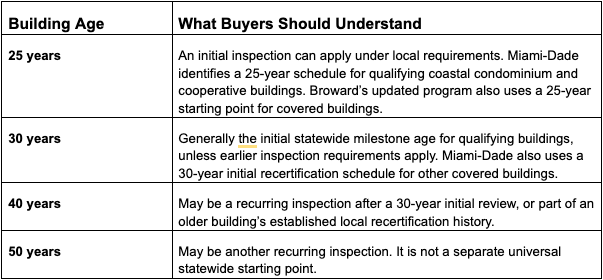
What Do the 25, 30, 40 and 50-Year Inspections Mean?
These numbers are often used interchangeably in real estate conversations. They should not be.
Florida’s statewide milestone-inspection law generally applies to qualifying residential condominium and cooperative buildings of three or more habitable stories. The initial inspection is generally required at 30 years, followed by inspections every 10 years. A local enforcement agency may require the first inspection at 25 years because of local circumstances, including environmental conditions.
Local recertification programs add another layer.
Photo Courtesy: Sebastian Acosta
Miami-Dade and Broward guidance shows why an older reference to a “40-year certification” is not enough to establish a building’s current obligations. Buyers should obtain its actual inspection history and confirm the next deadline with the relevant building department.
Age is a starting point for questions. The more revealing information is what inspections found, what work was completed, and what remains planned.
Reserves Are Becoming Part of the Value Conversation
A structural integrity reserve study, commonly called a SIRS, estimates funding needs for specified building components. It is separate from a milestone inspection.
Florida generally requires these studies at least every 10 years for qualifying condominium buildings. Current law restricts the routine waiving of required structural reserves, while allowing certain funding alternatives and conditional temporary pauses.
HB 913, which became law in 2025, added flexibility, including the use of loans and lines of credit under specified conditions. Buyers should therefore examine both reserve balances and association debt. If contributions have been temporarily reduced, ask when they resume and what that means for future payments.
The financial question is broader than how much cash is in an account. Does the association have a credible funding plan, and what will that plan require from this particular unit?
A building that has completed substantial improvements may deserve a different valuation from one still estimating its costs. The documents should establish that distinction.
A Financing Change to Watch in 2027
One important development comes from mortgage underwriting rather than Florida legislation.
Fannie Mae retired its Limited Review process for loan applications dated August 3, 2026 onward. Previously eligible projects must use Full Review or an applicable project-review waiver.
For applications dated January 4, 2027 onward, its standard Full Review reserve-allocation requirement increases from 10% to 15% of annual budgeted assessment income. A qualifying reserve-study alternative remains subject to Fannie Mae’s requirements. These are lending eligibility standards, not a blanket Florida mandate requiring every association to contribute 15%.
Buyers using financing should have their lender review the building early. Cash buyers should also consider financing accessibility when evaluating a future resale audience.
More Information Should Make Comparisons Better
Another recent change concerns access to association records.
Beginning January 1, 2026, associations managing condominiums with at least 25 units, excluding timeshare units, must make specified records available through a website or mobile application. Required materials include budgets, financial reports, certain meeting records, inspection reports, and the latest applicable SIRS. Some information is accessible through protected owner access, so buyers should arrange document delivery through the seller and association.
That makes document organization a useful part of the buying process. Ask for a complete package early enough to review it within the transaction’s deadlines.
Where the Opportunities Can Be
An older building with completed improvements, documented inspections and a workable funding plan may offer compelling value. A newer building may justify a premium through its condition, services, and suitability for the buyer.
Neither age nor a reduced asking price settles the investment question.
For a rental purchase, calculate expected income after association fees, property taxes, insurance, maintenance, management, and vacancy. Then consider financing separately to understand cash flow after debt payments. Confirm rental permissions before relying on projected revenue.
For a primary or seasonal residence, weigh carrying costs alongside the value of personal use and the expected ownership period.
An assessment does not automatically eliminate an opportunity. Its amount, purpose, payment schedule, and contractual allocation need to be reflected in the purchase analysis.
The Right Advisor Should Understand the Numbers
Photo Courtesy: Sebastian Acosta
A capable agent should help buyers connect the property search with financial analysis.
That includes comparing completed sales, identifying differences in building obligations, reviewing ownership-cost assumptions, and coordinating early with the lender, attorney, inspector, and insurance professional.
An agent with financial fluency can help a buyer recognize when an attractive price represents value, and when another property offers a better overall fit. Engineering findings and legal conclusions still belong with the appropriate licensed professionals.
Florida condos can remain worthwhile investments for buyers who select carefully, negotiate intelligently, and understand what they are buying. Current conditions provide opportunities worth investigating. Turning one into a successful purchase requires disciplined analysis and strong representation.
The goal is to buy a home you enjoy, at a price you can explain, in a building whose plans you understand.
Connect with Sebastian Acosta
For help comparing Miami condominium opportunities and understanding ownership costs, contact Sebastian Acosta.
Global Real Estate Advisor | ONE Sotheby’s International Realty
Disclaimer: This article is for informational and educational purposes only and should not be considered financial, investment, legal, or real estate advice. Real estate market conditions, regulations, and lending requirements are subject to change. Readers are encouraged to consult qualified real estate, financial, and legal professionals before making any property purchase or investment decisions.