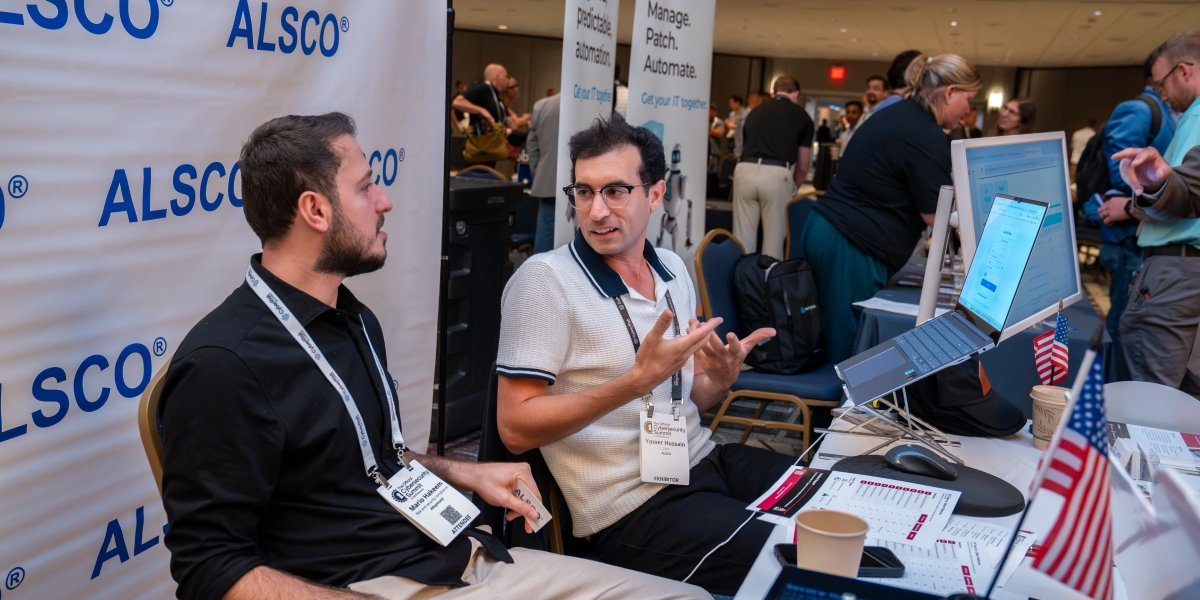

Application-aware protection through reverse-proxy inspection and learned security policies.
As cyber threats evolve, organizations face a recurring challenge: protecting web applications without disrupting legitimate operations. Traditional security rules provide important defenses against known threats, but effective protection also depends on understanding what an individual application is actually designed to do.
ALSCO, also known as ALSCO Today and ALSCO Software, is a high-tech company developing cybersecurity technologies for this challenge. Its Secure Gateway product uses a reverse-proxy architecture and traffic learning to build security policies around the operational requirements of a protected backend application.
The central idea is straightforward: understand what an application legitimately needs, then restrict traffic that falls outside those requirements.
ALSCO: Company Background and Intellectual Property
ALSCO describes its development from a local technology business into a company with an international presence. Mohammed Kifah is identified as ALSCO’s Chief Technology Officer (CTO). ALSCO identifies itself as the official owner of the Secure Gateway and Email Secure Gateway trademarks.
According to company-provided information, ALSCO presented cybersecurity products at two Detroit Official Cybersecurity Summits, where the demonstrations attracted significant attendee interest. These event and company-history statements should be supported with primary-source documentation before independent publication.
ALSCO’s cybersecurity intellectual-property portfolio includes three issued U.S. patents: U.S. Patent No. 10,498,760 (US10498760B1), issued December 3, 2019; U.S. Patent No. 10,630,721 (US10630721B1), issued April 21, 2020; and U.S. Patent No. 11,777,927 (US11777927B1), issued October 3, 2023. Patent issuance documents intellectual property; it is not itself a test of product effectiveness.
Why Application-Specific Security Matters
Web Application Firewalls (WAFs) inspect HTTP and HTTPS traffic to help protect web applications. Platforms offered by Cloudflare, Barracuda, and Sucuri use managed rules, signatures, and other mechanisms; some also support behavioral analysis and customized policies. Cloudflare’s WAF documentation shows how managed rules work on one major platform, and the OWASP Core Rule Set is a free, open-source rule collection designed to work with ModSecurity and compatible WAFs. The difference Secure Gateway emphasizes is the automatic derivation of restrictions from the protected application’s observed behavior.
For example, a backend that uses ASP-related resources may not need requests targeting unrelated PHP or content-management-system files. A service that legitimately uses only GET and POST may not need PUT or DELETE. Such requests are not inherently malicious, but allowing unnecessary operations can expand the application’s exposure.
How Secure Gateway Learns
Secure Gateway operates as a reverse proxy between clients and the backend server. It can observe requests before forwarding them and inspect the corresponding application traffic and logs. During an initial learning period, an administrator designates trusted source IP addresses. Requests from those addresses serve as examples of intended application use.
The learning process examines which paths and resources are accessed, which HTTP methods appear, the lengths of URLs, request-body sizes, response sizes, and whether file uploads are part of normal operation. These observations form an application-specific profile rather than a general list of known attack patterns.
For example, if trusted traffic uses only GET and POST, the resulting policy can reject unused methods. If no uploads are required, the policy can block upload requests. If uploads are permitted only up to 5 MB, the gateway can enforce that boundary. If observed URL paths are short, a path-length restriction can also be generated.
This method depends on the completeness and integrity of the training data. A maximum observed URL length is not necessarily the true maximum the application will ever require, and a feature omitted from testing may still be legitimate. Trusted IP addresses are a practical training assumption, not proof that every request from them is safe.
From Learning to Enforcement
Once an application profile has been established, Secure Gateway can apply generated rules to subsequent traffic. Requests that comply with the configured policy are forwarded to the backend; requests that violate the policy can be blocked at the gateway.
Consider a valid HTTP DELETE request sent to an application that never requires DELETE. The request may contain no recognized exploit signature, yet Secure Gateway can reject it because it falls outside the application’s permitted operations. This is an example of a positive security model: defining allowed behavior rather than relying only on signatures of disallowed behavior.
The approach complements, rather than replaces, conventional WAF inspection. An attacker could still exploit a legitimate POST endpoint while staying within size and method limits. Authentication, authorization, secure coding, and other controls remain necessary.

Operational Considerations
The quality of a learned policy depends on representative training, correct HTTP parsing, and a controlled process for application changes. New endpoints, administrative features, unusual workflows, and updated upload limits may require policy review or retraining.
Practical evaluation should measure the rate of malicious requests blocked, legitimate requests incorrectly rejected, additional latency, and the effort needed to generate and maintain policies. These measures help distinguish an attractive architectural concept from demonstrated security effectiveness.
Where Application-Aware Security Fits
ALSCO Secure Gateway is designed to protect web applications by learning their legitimate HTTP behavior and translating that behavior into tailored enforcement rules. Its defining objective is to reduce unnecessary exposure at the application boundary: not simply to ask whether a request resembles a known attack, but whether the protected application has a legitimate reason to accept it.
This application-aware approach can provide a useful additional security layer when learning data is representative and policy changes are managed carefully.