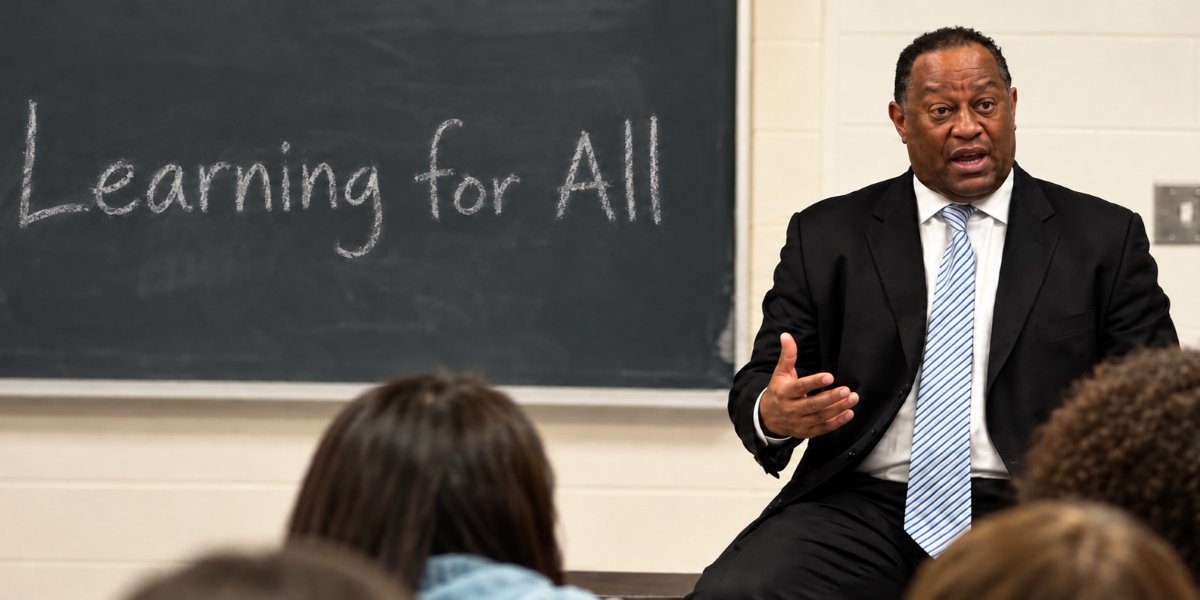

Christopher M. Spence’s To Be Seen and Heard asks educators to begin with the voices, strengths and lived experiences of African American young men, and to build schools where belonging and achievement grow together.
Every new school year begins with hope. Students walk through the doors carrying new goals, new anxieties, and possibilities that may not yet be visible to the adults around them. Teachers prepare to reach learners whose experiences differ widely. Families place their trust in schools once again. For educators committed to the success of Black boys, this moment offers more than a fresh calendar. It offers another opportunity to listen more carefully, remove barriers, and create the conditions in which young men can thrive.
That is the central invitation of Christopher M. Spence’s 2025 book, To Be Seen and Heard: Uplifting Our African American Males from Boys to Men. The title expresses both a need and a challenge. Black boys are frequently discussed through graduation rates, disciplinary data, and public narratives about risk. Spence asks educators to look beyond those categories and listen to the intelligence, humor, resilience, leadership, aspirations, and humanity of the young people represented by the numbers.
The book grew from Spence’s 2024 qualitative phenomenological study, To Be Seen and Heard: Strategies That Support the Academic Success of African American Males in Northern Chicago High Schools. He interviewed 12 recent African American male graduates about the experiences and relationships that contributed to their success. A qualitative study of this size does not claim to speak for every Black boy or every school. Its value lies in what the participants’ accounts reveal about the conditions that mattered in their own educational journeys.
Those young men did not describe success as an individual accomplishment achieved in isolation. They spoke about mothers and family members who held expectations for them, peers who provided brotherhood, coaches and mentors who offered guidance, educators who believed in their ability, and schools that gave them reasons to feel connected. They also spoke about racial identity, stereotypes, unequal treatment, personal responsibility, and the importance of having a meaningful future to work toward.
The message for a new school year is both hopeful and demanding. Black boys do not need schools to rescue them from who they are. They need schools to recognize who they are, cultivate what they bring, and respond honestly to the barriers that can limit opportunity. The most productive question is not, “What is wrong with these students?” It is, “What do these young people need from us, and what are we prepared to change?”
Belonging is a powerful place to begin. One of the recurring ideas in Spence’s work is that achievement and belonging cannot be separated. A student may be enrolled in a school without feeling that the school was built with him in mind. He notices whose history appears in the curriculum, who is trusted with leadership, whose behavior is interpreted generously, and who is watched with suspicion. He also notices which adults know his name, ask about his interests, attend his events and refuse to lower expectations for him.
A welcoming school does not mean an environment without standards. Spence argues for high expectations matched by high support. Black boys should encounter rigorous instruction, honest feedback and meaningful accountability, but discipline must remain proportionate, educational and connected to a path back into learning. Exclusion should never become the default response to behavior that could be addressed through relationships, guidance, restoration and appropriate support. The objective is not merely compliance. It is growth.
Representation also matters. Participants in Spence’s research raised concerns about the limited presence of African American male educators and the power of seeing successful adults who reflected aspects of their own identity and experience. Hiring more Black male teachers is not a complete solution, and Black boys can form life-changing relationships with educators of every background. Yet representation widens the range of adults students can imagine becoming and challenges the idea that Black male excellence is exceptional rather than expected.
Mentoring can extend that circle of possibility. Spence recommends relationships with both role models and “soul models,” adults who do more than display achievement and who are willing to listen, remain present, share experience, and help a young person develop character, confidence, and purpose. The strongest mentoring is not an occasional speech or ceremonial program. It is a dependable relationship built over time, especially when a student makes a mistake, faces disappointment, or begins to doubt his own potential.
Schools can also create networks that connect current students with African American male graduates. Success becomes more believable when young people can see and speak with those who have navigated similar classrooms and moved into college, training, employment, service, entrepreneurship, or other meaningful adult pathways. Alumni can make possibility visible while also providing practical knowledge about the transitions that await students beyond graduation.
Family partnership must be equally intentional. The young men in Spence’s study repeatedly described the influence of mothers and other relatives who supported, pushed, and advocated for them. Schools honor that commitment when families are welcomed before a problem occurs, treated as knowledgeable partners, and connected with resources that strengthen both academic progress and emotional well-being. Communication should not begin with discipline and end with a report card. It should become part of the relationship surrounding the student.
Listening to Black boys themselves remains essential. Student voice is sometimes reduced to a survey or an invitation to speak after decisions have already been made. To be seen and heard requires something deeper. It means asking young men what helps them learn, where they feel connected, which barriers they experience, and what futures they imagine. It also means allowing their answers to influence instruction, mentoring, school culture and opportunity.
Spence’s perspective is informed by more than research. Across decades as a teacher, principal, system leader, author and mentor, he has seen young people respond when adults combine belief with structure and care with accountability. He has also seen how quickly talent can be overlooked when a student is reduced to a stereotype, a disciplinary incident, a test score, or someone else’s lowered expectation. To Be Seen and Heard continues a lifelong argument: talent is everywhere, but opportunity is not.
The beginning of a school year gives leaders and educators a rare chance to establish new patterns before old ones harden. Learn every student’s name. Examine who has access to advanced courses, leadership opportunities, the arts, athletics, and mentoring. Review discipline for disproportionality. Build relationships with families early. Recruit and retain diverse educators. Create spaces in which Black boys can speak honestly, develop brotherhood and see successful futures reflected around them.
None of these actions promises a simple or immediate solution. The experiences of African American young men are not uniform, and meaningful improvement requires sustained attention rather than a seasonal initiative. But the graduates whose voices shaped Spence’s work provide reason for hope. Their stories show what can happen when ability is recognized, expectations remain high, relationships are genuine, and a young person knows that his presence matters.
As classrooms fill again, the challenge is not simply to help Black boys survive another school year. It is to build schools in which they can discover their strengths, exercise leadership, experience joy, recover from mistakes and pursue ambitious futures. Before educators can fully teach them, schools must be prepared to see them. Before leaders can decide what they need, they must be willing to hear them. That is where hope becomes practice, and where a new school year can become the beginning of something different.