
In manufacturing environments where tolerances are measured in microns, the condition of cutting tools directly influences output quality. Milling cutters, drills, and specialty blades lose efficiency over time, and reconditioning processes become necessary to maintain dimensional accuracy. Tool-grinding systems, therefore, occupy a steady position in industrial workshops, even as automation and computer-controlled machining continue to evolve. Over the past several decades, changes in motor technology and abrasive materials have reshaped sharpening practices. Within this landscape, CUTTERMASTER systems produced by Cuttermasters illustrate how established equipment designs have been updated through technical adaptation.
Cuttermasters was founded in 2000 by Jeff Elias Toycen in Canada. Prior to establishing the company, Toycen began working in 1994 on projects involving direct current motor systems under Toycen Industries. That early focus on DC motor technology later influenced the redesign of grinding equipment marketed under the CUTTERMASTER name. The original CUTTERMASTER end mill sharpener, patented in the late 1970s in the United States, remained in widespread use for decades. Company estimates suggest that approximately 35,000 Cuttermaster machines are in operation globally, with about 7,000 located in the United States.
Beginning in 2004, Cuttermasters initiated development of the CUTTERMASTER Professional series. The project aimed to modernize the earlier end mill sharpener while preserving its core function of restoring milling-tool geometry. End mills are essential in computer numerical control machining, and their reconditioning can reduce replacement costs. Rather than introducing a completely new concept, the Professional series represented a revision of an existing platform, incorporating updated components and adjustments to accommodate contemporary workshop requirements.
A central element of this redesign involved motor systems. By 2010, Cuttermasters had developed a functional DC control system for integration into its grinders. Direct current motors allow variable-speed adjustment through voltage control, providing operators with greater flexibility during sharpening. Speed influences grinding pressure, surface finish, and heat generation. In tool maintenance, excess heat can affect temper and material structure, making motor control an important consideration. The adoption of DC systems reflected technical decisions rooted in Toycen’s earlier engineering work beginning in 1994.
The integration of DC motor technology also contributed to the introduction of the Tradesman DC Bench Grinder in 2010. Initially associated with the woodturning community, the Tradesman model incorporated variable-speed control to manage heat during precision grinding operations. Bench grinders are widely used in maintenance shops, and adjustable speed can be useful when working with different materials or abrasive wheel compositions. The Tradesman Machinist Version extended this approach into machine-shop applications, where consistent tool geometry is necessary for repeatable machining outcomes.
In 2015, the Tradesman Machinist Version received a United States patent covering aspects of its DC drive system and its use of CBN precision-plated grinding wheels. Cubic boron nitride is valued in industrial contexts for its hardness and ability to maintain shape under elevated temperatures. Precision-plated CBN wheels are often used to sharpen high-speed steel and carbide tools. Patent recognition in 2015 provided formal acknowledgment of the configuration developed by Cuttermasters, linking DC drive integration with specialized abrasive materials.
Subsequent developments expanded the technical scope of the company’s equipment. In 2017, updated versions of the CUTTERMASTER Professional grinder were released alongside the Tradesman Machinist Grinder. These revisions continued the use of variable-speed control and DC-driven systems. In January 2020, Cuttermasters acquired the CUTTERMASTER Professional trademark, followed in June 2020 by the purchase of inventory from Conquest Industries, also known as Cuttermaster. After consolidating brand ownership, the company introduced redesigned models, including the Journeyman JXT, which featured an articulated DC motor mounted on a vertical axis to increase grinding flexibility.
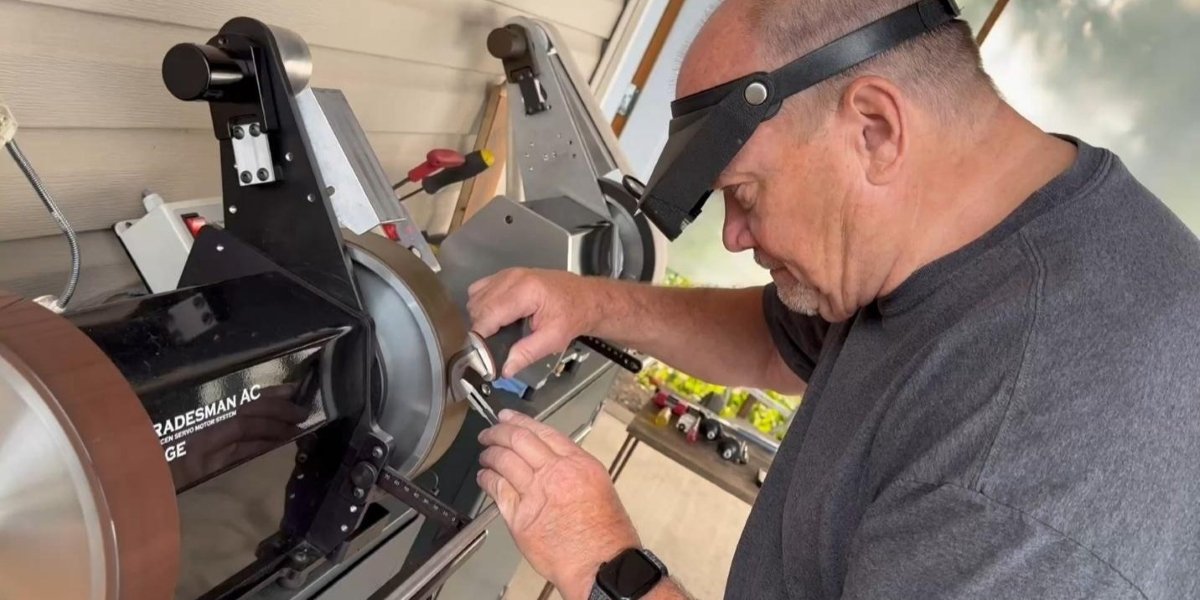
Innovation extended beyond wheel-based grinders. In 2022, Cuttermasters developed the EDGE Geared Belt Bench Workstation, a modular grinding and sanding station designed for knife manufacturers and sharpening professionals. Belt-grinding systems differ from traditional wheel grinders in their ability to provide broader surface contact and a wider range of finishing techniques. In 2023, an AC servo motor version of the EDGE workstation was introduced, indicating the company’s exploration of motor configurations beyond direct current systems while maintaining adjustable-speed functionality.
Also in 2023, Cuttermasters launched the Bladesman belt grinder line. The Bladesman system was designed for professional sharpeners seeking belt-based platforms suited to shaping and finishing operations. While wheel grinders are often associated with precise geometry restoration, belt grinders can also handle profiling and surface refinement. The addition of belt-grinding equipment reflects a diversification of the company’s sharpening technologies beyond its original focus on end mills.
Amid these developments, Cuttermasters has maintained in-house design, rapid prototyping, assembly, and product redesign processes at its facilities in Canada. Engineering operations are located in Ottawa, with distribution facilities in Smiths Falls, Ontario, and Ogdensburg, New York. This structure enables iterative adjustments to mechanical components, motor mounts, and abrasive configurations in response to user technical feedback. Equipment has been distributed through industrial suppliers, including MSC, Grainger, Fastenal, Motion Industries, Travers Tool, and Blackhawk Industrial.
The development of DC motor systems, variable-speed control systems, and precision-plated CBN wheels has impacted sharpening technologies in metalworking and knife production. The aerospace and automotive industries have seen the implementation of Cuttermaster systems by companies such as NASA, SpaceX, Tesla, Boeing, the United States Navy, and the Canadian National Research Council. Grinding technologies form an element of the overall production sequence of the manufacturing process. It is an aspect of the machine tool process that has evolved in motor control systems.
The development of motor control systems in grinding technologies has evolved from the initial implementation of the DC motor system in 1994 to patented systems in 2015 and the development of belt grinding systems in 2022 and 2023. This has been an incremental change rather than a significant shift in the overall development of the machine tool process. Under the guidance of Jeff Elias Toycen, the company has driven evolution in sharpening and grinding technologies.