
By: Christopher Graves
There is a moment in David Moore’s memoir that is brief enough to pass quickly but resonates long after the page has turned. His wife walked into the bathroom while he was toweling off after a shower in November of 1998 and told him the stock had jumped ten points. He was doing the math instantly. Every dollar was a million to him. His net worth had increased by ten million dollars while he was washing his hair, in the time it took to rinse out the shampoo.
Eighteen months later, that money was gone. Not dramatically. Not in a single catastrophic event. Just gone, the way paper wealth goes, through a sustained decline that eroded everything before anyone had agreed on a moment to call it final.
Ten senior executives sat in Mark Moran’s office in late 2001 contemplating a bankruptcy filing partly because fifteen million dollars in options between them had become a few hundred dollars in market value. The money they had counted had never been real in the way they had treated it as real. Paper wealth is a story you tell yourself, and the story ends on a schedule you didn’t set and weren’t consulted on.
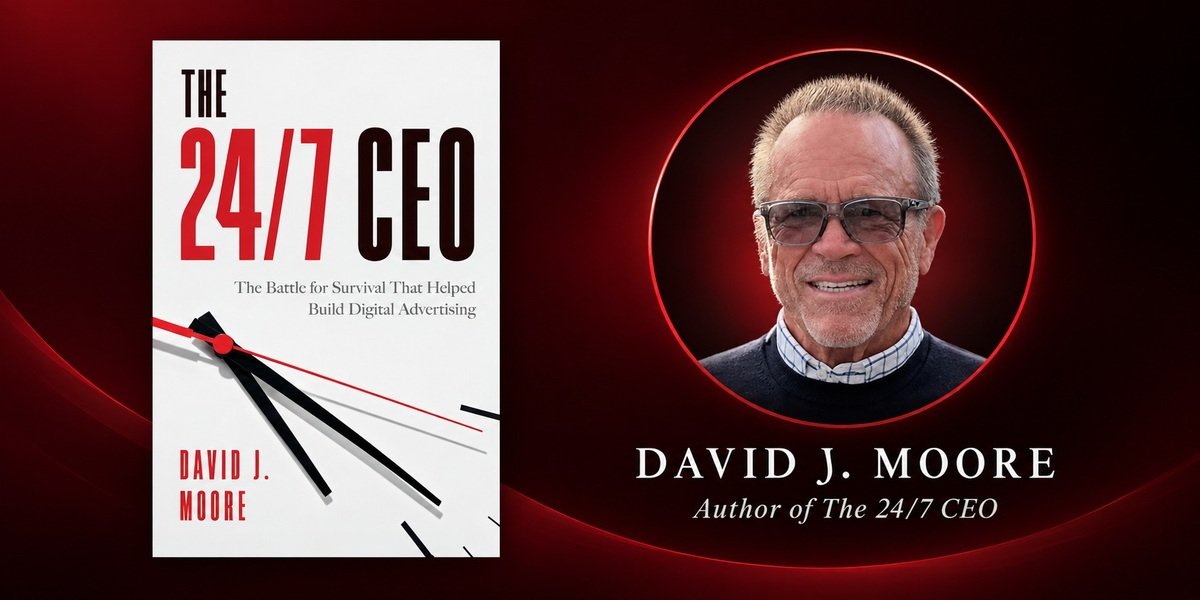
The 24/7 CEO was written in part to make sure the next generation of founders and executives understands that before they live it. The understanding is available in advance, but it requires someone willing to tell the story without protecting their own image more than they protect the reader’s education.
What Business Schools Leave Out
The things David most wants a first-time founder to understand are precisely the things that almost never appear in the success stories, the ones that skip from early traction to successful exit and treat everything in between as a montage.
The money isn’t yours until it’s in the bank. A great idea without sufficient capital isn’t a business. It is a hobby with a pitch deck. He learned the capital lesson the hard way with a company called Geomedica in 1993, when the company funded itself with advertiser deposits and missed payroll by a single day before a Reuters acquisition closed and resolved the crisis. One day. The lesson from that experience informed every subsequent decision he made about cash reserves and capital buffers, even if the dot-com boom environment made those lessons temporarily harder to apply when every board was telling every CEO to spend faster.
In any period of significant disruption, cash is the single resource that buys you the time to be wrong once and still be present to be right the next time. All of the other advantages, the better technology, the stronger team, the more compelling vision, are contingent on being alive long enough to realize them.
What He Put In and Why
David is a salesman by training and salespeople appreciate a story that teaches through entertainment rather than through instruction, so he leaned toward inclusion rather than toward protection of his own image. The manufactured data room. The error message on the Pfizer demo. Walking into his wife’s dinner party with a ripped shirt and blood on his chest. These are in the book because they happened and because they are instructive and because he thinks people retain lessons that arrive wrapped in genuine narrative.
The harder decisions were about what to include that was painful rather than merely embarrassing. He went back and forth extensively on how much to say about Ted Ammon, a colleague with whom he had a serious professional conflict who was later murdered. He eventually included it because Mark Moran offered a characterization that felt accurate and fair: Ted was difficult for three months and essential for four years. 24/7 would not have survived its first ninety days without him.
The chapter about his wife Ioanna was the hardest thing he has written. He did not want the book to be about her illness, and he also understood that an honest account of his life during this period could not leave her out. The chapter is there. He is glad it is in. Some things belong in the record even when they are the hardest things to put there.
The survival story told with the honesty most business books avoid. The 24/7 CEO by David Moore is available now on Amazon.