
By Kate Sarmiento
There is a particular kind of pressure that follows success in business, and if you have ever built something genuinely good, you know exactly what it feels like. At some point, the conversations stop being about the work itself and start becoming about expansion. Investors circle. Trade publications start asking about growth plans. And somewhere in all that noise, the thing that made your business worth building in the first place starts getting pushed further into the background.
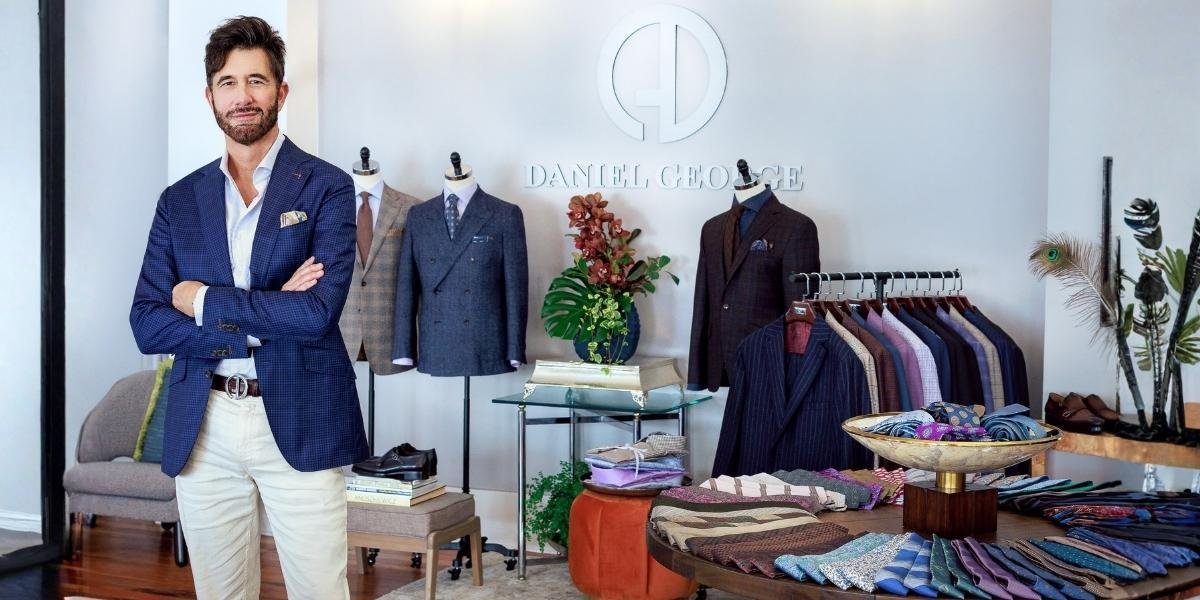
Daniel George, founder of Daniel George Custom Menswear, has been staring that pressure down since 2012, and he keeps choosing the same answer: no. Not because the opportunities were not real. Cities like New York and Los Angeles came calling. The numbers probably would have worked on paper. But Daniel built something that does not survive being franchised, delegated, or stretched across markets where the standard depends on people who did not spend decades learning the craft firsthand. His business challenges the idea that growth is automatically progress, and in a menswear market flooded with “custom” suits that barely deserve the label, that restraint has quietly become part of the brand’s advantage.
The men who walk through his showroom doors are not looking for a fast transaction. They are looking for someone who can tell them, honestly, that the cut they requested does not actually work for their frame, and then explain why. That level of honesty requires trust, and trust requires presence. It requires the person behind the standard to still be directly involved in maintaining it.
What Actually Happens When a Founder Leaves the Room
The business world loves a clean story about scaling. You build something great, systematize it, hire capable people, and eventually step back while the company runs smoothly without you. That model works for some businesses. It becomes far more complicated in industries built around judgment, craft, and human nuance.
When Daniel George sits across from a client, he is not simply taking measurements. He is reading posture, noticing where tension sits in the shoulders, watching how someone naturally stands when they stop thinking about it. Those details shape the garment. They are the difference between a suit that technically fits and one that looks natural on the body wearing it.
Luxury brands often lose their edge the moment the person who built the standard becomes too removed from the actual work. Service quality tends to decline as organizations scale and leadership shifts from operational involvement to administration, particularly in high-skill industries where tacit knowledge drives results (Source: Harvard Business Review, 2026). The issue is not that new employees are untalented. The issue is that some forms of expertise cannot be fully documented. You can teach measurements, but you cannot fully teach instinct, restraint, or taste.
Daniel George takes more than fifty measurements per client, but the process goes beyond numbers. He adjusts for posture, for asymmetry, for the way a person carries themselves professionally versus socially. He will tell a client directly when a color is aging them or when a lapel width is throwing off their proportions. That directness is part of the experience clients are paying for. It disappears quickly in businesses trying to move appointments faster or standardize consultations across multiple locations.
The menswear industry is full of examples of brands that lost their identity after aggressive expansion. The garments may have remained technically similar, but the experience changed. And in luxury, the experience is often what clients remember most.
Growth Does Not Ruin Businesses. The Wrong Kind of Growth Does.
To be clear, Daniel George is not arguing that ambition is a problem or that every business should stay small. The argument is much narrower and much more practical than that. Some businesses are built around a level of personal involvement that cannot be mass-produced without weakening the thing clients originally valued.
Custom menswear, when done properly, is one of those businesses.
The construction process at Daniel George includes full-canvas workmanship on every coat, hand-pressed finishing throughout production, hand-cut fabric, and pic stitching along the edges. The process takes seven to eight weeks because that is how long the work requires. Speeding that process up to increase output would fundamentally change the product itself.
In premium service industries, client retention and lifetime value often outperform acquisition-heavy growth strategies, especially when quality and trust matter more than convenience or price (Source: McKinsey Global Institute, 2023). Daniel George’s business reflects that model in practice. His clients return repeatedly. They bring colleagues, sons, friends, and groomsmen who noticed the difference during weddings or events. That kind of loyalty is difficult to manufacture at scale because it depends on consistency over time.
There is also another challenge the modern luxury market created: the word “custom” barely means anything anymore. Many clients arrive assuming bespoke simply means choosing from a few fabric swatches while someone spends twenty minutes taking measurements. By the time they experience an actual custom fitting process, the standard has already been lowered by years of marketing language.
That means Daniel George often spends part of the appointment re-educating clients on what true custom tailoring is supposed to feel like in the first place. That only works because the person explaining the difference is also the person responsible for the work itself.
High-net-worth consumers are increasingly prioritizing authenticity and craftsmanship over pure brand recognition, with growing interest in smaller founder-led luxury businesses over conglomerate labels (Source: Deloitte, 2023). In many ways, the market is moving toward what Daniel George has been doing all along.
Ready to Find Out What Custom Actually Means?
Daniel George did not stay intentionally small because he lacked ambition. He stayed focused because he understood what clients were actually coming to him for, and he understood that expanding too aggressively risked weakening the very thing that made the experience valuable.
His showrooms in Chicago, Lake Forest, and San Francisco operate by private appointment. That is not just a scheduling preference. It is part of the structure of the experience itself: one client, one designer, uninterrupted attention, and no shortcuts. Clients are given direct feedback because the goal is not simply to complete a sale. The goal is to make sure the garment is right before it ever leaves the showroom.
Every suit also comes with a full refund guarantee within four months of purchase, which is rare in custom menswear and reflects the level of confidence Daniel George places in the work.
Most men already know the difference between wearing something acceptable and wearing something that feels completely natural the second it goes on. That difference is usually not branding, trends, or logos. It is precision, proportion, and attention from someone who still cares enough to stay personally involved in the process.
Schedule a private appointment to experience what custom menswear looks like when the person behind the standard is still the one delivering it.