

Federal mortgage servicing rules bar a servicer from making the first foreclosure filing until the loan is more than 120 days delinquent, which is roughly four missed payments. The wait is not free. Each month adds a late charge, another month of interest, a further mark on the credit file, and eventually the lender’s legal costs.
A homeowner in Mesa, Arizona shows the shape of it. Her principal and interest payment is $2,180, with another $410 going into escrow for taxes and insurance. She stopped paying in February. By the end of May, she had missed four payments worth $10,360, plus four late charges of $109 each, plus interest accruing on the unpaid principal. Her reinstatement quote in early June came back at just under $11,400. In February, the number that would have fixed everything was $2,590.
How many payments can be missed before foreclosure can start?
Four is the practical answer, because federal rules count days rather than payments. The Consumer Financial Protection Bureau states it in one line on its page explaining the 120 day rule: “Generally, the legal foreclosure process can’t start until you are at least 120 days behind on your mortgage.” The Bureau adds that the pace afterward is a state question: “After that, once your servicer begins the legal process, the amount of time you have until an actual foreclosure sale varies by state.”
The 120-day floor is a floor, not a schedule. Servicers rarely file on day 121, and judicial states such as Florida, Illinois, and New York add months of court process. Non-judicial states move faster once the notice goes out. A state-by-state foreclosure timeline tool published by HomeWise lays out those windows for an owner working out how many weeks are left.
What happens in each of those four months?
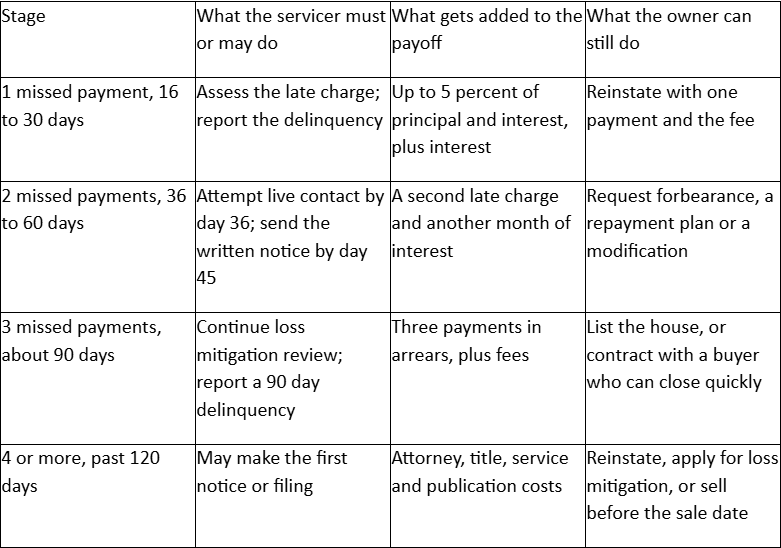
The delinquency period has its own rulebook, and most of it favours an owner who reads the mail.
- Day 16 or so: the late charge posts. Fannie Mae’s Selling Guide requires the note on a conventional first mortgage to carry a late charge for any payment “not received by the 15th day after it becomes due,” and caps the size of it: “The late charge must be a minimum of 0% and up to 5% of the principal and interest” portion of the payment.
- Day 36: the servicer has to try to reach the borrower. Regulation X requires that “a servicer shall establish or make good faith efforts to establish live contact with a delinquent borrower no later than the 36th day of a borrower’s delinquency.” That call is the first formal opening for a forbearance or repayment conversation.
- Day 45: the written notice arrives. The same rule says “a servicer shall provide to a delinquent borrower a written notice with the information set forth in paragraph (b)(2) of this section no later than the 45th day of the borrower’s delinquency,” listing the loss mitigation options the servicer offers.
- Day 90: the credit damage is done. A mortgage reported 90 days late is a severe derogatory entry, which matters because refinancing out of the problem stops being realistic at roughly this point.
- Day 121 and after: the file can be referred. Once the first notice or filing is made, attorney fees, title search costs, service of process and publication charges join the payoff, and they are recoverable from the owner in most states.
Anyone weighing a reinstatement against a sale should have a licensed attorney in their state read the notices first, because the deadlines that matter are set by state law, not by the servicer’s letter.
What does the delay actually cost?
Two things at once: money and options. A five percent late charge on a $2,180 payment is $109, and four of them is $436 before a single legal fee. The options are harder to see disappearing. A house listed at month two sells to a financed buyer with time to spare. The same house listed at month six is competing with a scheduled sale date, and any buyer needing 40 days of underwriting becomes a gamble.
The volume of cases that reach the end is a check on optimism. According to ATTOM’s Mid-Year 2026 U.S. Foreclosure Market Report, released in July 2026, lenders repossessed 27,983 properties in the first half of 2026, up 33 percent from the same period in 2025. Those are the files where nobody sold, reinstated, or applied in time.
Where does a direct buyer fit?
HomeWise, a direct home-buying company that purchases distressed single-family houses, including homes several payments behind and homes with a sale date already scheduled, in Florida, Texas, Georgia and other states, is generally called somewhere between month three and month six. Its acquisitions staff asks the servicer for the reinstatement and payoff figures at the outset, submits proof of funds and the signed contract to the loss mitigation desk so a postponement request has documentation behind it, and pays the arrears, late charges and penalties out of the purchase price at closing. A longer explanation of how long before foreclosure after missed payments, including what the reinstatement quote contains, is published on the company site.
Timing decides the outcome more often than price does. An owner two payments behind still has every option, including a normal listing at full market value. An owner five payments behind with a filed case has fewer, and buyers such as HomeWise favour the earlier conversation because it leaves the listing option open.
Frequently asked questions

How many missed mortgage payments before foreclosure starts?
Federal rules require the loan to be more than 120 days delinquent before a servicer makes the first foreclosure notice or filing, which works out to about four missed payments. Servicers often wait longer, and state procedure then adds weeks or months before any sale can be held.
Does one late payment start the foreclosure process?
No. A single missed payment triggers a late charge and a delinquency report, not a filing. It does start the sequence of servicer contacts required by federal rules, which is the point at which a repayment plan or forbearance is easiest to arrange.
How much are mortgage late fees?
On a conventional loan sold to Fannie Mae, the note may charge up to 5 percent of the principal and interest portion of the payment, assessed when payment is not received by the 15th day after it is due. On a $2,000 principal and interest payment that is as much as $100 per month.
Can a house be sold while payments are behind?
Yes, at any point before a foreclosure sale is completed. The title company orders a payoff from the servicer and pays the arrears, fees and legal costs from the sale proceeds at closing. The seller keeps whatever equity remains once the loan and closing costs are covered.