
Every established business reaches moments where growth needs capital before revenue catches up. A restaurant adds a second location. A contractor wins its biggest job yet. An online brand sees demand outpace inventory. The question isn’t whether to fund growth, but how to do it quickly without taking on the wrong kind of debt.
Fundivi, a business funding platform focused on fast decisions, works with owners in situations like these. This guide follows five fictional established businesses through common growth situations, showing which type of Fundivi product might fit each one and why. The businesses and figures are illustrative, and every decision depends on each company’s qualifications.
Before the Stories: Fundivi in Brief
Fundivi is headquartered in Brooklyn, New York, and says it serves qualified businesses in all 50 states. The company offers a broad menu of funding products. Most range from $10,000 to $5 million, and some structures, such as asset-based loans, go higher. According to the company, its application takes minutes, decisions can arrive within hours for several core products, and funds can be disbursed the same business day after an offer is accepted, subject to bank verification.
Fundivi states that fees and terms are itemized in a written offer before commitment. Collateral and personal guarantee requirements vary by product and deal size. The company says smaller term loans are typically unsecured with a personal guarantee, while larger loans are usually secured by a UCC-1 filing on business assets. Prepayment terms also depend on the product, and Fundivi says it discloses the schedule before signing.
Story 1: The Restaurant Opening a Second Location
The business: A fictional Mediterranean restaurant, seven years old, with about $95,000 in monthly sales.
The need: $150,000 to build out a second location, with a lease signed and a contractor ready.
The challenge: The bank said it would need six weeks and a lien on the owner’s home.
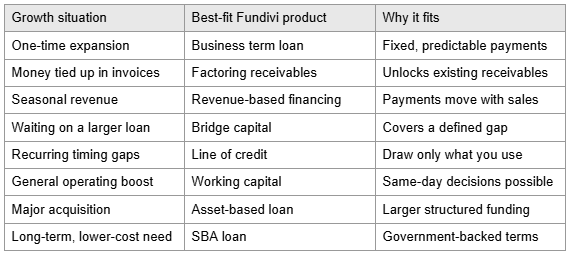
The Fundivi fit: A business term loan offers a lump sum with predictable fixed payments, which suits a one-time build-out with a long useful life. Fundivi says smaller term loans are typically unsecured, though a personal guarantee is common, and larger loans may be secured by a filing on business assets. The owner would want to review exactly what is pledged before accepting an offer.
The lesson: For a defined, one-time growth project, a term loan’s fixed schedule makes planning easier than a variable product.
Story 2: The Contractor Winning a Bigger Job
The business: A fictional commercial electrical contractor, nine years old, with lumpy but consistent revenue averaging $210,000 per month.
The need: Materials and crew wages for a $600,000 project, while two earlier jobs are still waiting on 60-day payments.
The challenge: Cash is tied up in receivables, not missing.
The Fundivi fit: Factoring receivables turns unpaid B2B invoices into an advance, so the contractor’s strong commercial customers matter most in this structure. Fundivi lists factoring decisions at one to two weeks, which makes it a product to arrange before cash gets tight. Owners comparing structures like this can find them on the Fundivi growth loans for small businesses page.
The lesson: When your money is stuck in invoices, unlocking it can be a better match than borrowing against future revenue.
Story 3: The Online Brand Scaling Inventory
The business: A fictional home goods brand, four years old, with $130,000 in monthly sales, mostly through its own website and one marketplace.
The need: $80,000 to place a large order ahead of the holiday season.
The challenge: Revenue spikes in the fourth quarter and slows in the first, so fixed payments could strain January.
The Fundivi fit: Revenue-based financing, where repayment is a percentage of ongoing revenue, lets payments rise in strong months and ease in slower ones. Fundivi says it structures repayment around each business’s cash flow, including flexible schedules for seasonal revenue.
The lesson: Match the payment rhythm to your sales rhythm. An overview of every product is available on the Fundivi growth funding platform.
Story 4: The Medical Practice Waiting on a Closing
The business: A fictional dental practice, twelve years old, buying the building it currently leases.
The need: $200,000 for equipment upgrades now, while an SBA-backed real estate loan closes in about two months.
The challenge: The equipment vendor’s pricing expires before the SBA closing.
The Fundivi fit: Bridge capital provides short-term liquidity tied to a defined future funding event. Fundivi describes bridge capital decisions within about three hours. Fundivi also lists SBA loans among its products, which can make coordination simpler.
The lesson: A bridge works best when the exit is documented. A signed commitment letter is the strongest evidence you can bring.
Story 5: The Service Firm With Uneven Cash Needs
The business: A fictional commercial cleaning company, six years old, with 45 employees and $160,000 in monthly revenue.
The need: Occasional cash to cover payroll when large clients pay late, sometimes $20,000 and sometimes $60,000.
The challenge: A lump-sum loan would mean paying for money that often sits unused.
The Fundivi fit: A business line of credit allows the company to draw only what it needs and repay as clients pay. Fundivi describes line of credit decisions in one to three days, so this is a product to open before the need becomes urgent.
The lesson: Recurring, unpredictable gaps call for revolving access, not repeated one-time loans.
Matching Needs to Products
What Established Owners Look For in a Funding Platform
The five stories share a pattern. Each owner had a healthy business, a clear growth opportunity, and a deadline a bank might not meet. Three features of Fundivi’s model line up with those needs.
• Speed. Fundivi says same-day funding is possible for qualified applicants.
• Range. The company lists a broad set of products, so the structure can be matched to the need.
• Transparency. Fundivi says total cost, fees, and terms are disclosed before commitment, and its rate-match program may match a better rate from a verified direct lender on a comparable structure.
Review sites have taken note, though readers should weigh how those sites are funded. Compare Small Business Loans, a comparison site that says it may be paid by some lenders, lists Fundivi first and names it an editor’s choice on its Compare Small Business Loans top lender list. Check how any review site evaluates lenders, and use ratings as a reason to compare terms closely.
Planning Your Own Growth Funding
Before applying, write down three things:
• The exact amount and what it will pay for
• How the investment will produce or protect revenue
• When that revenue will arrive
Those answers point to the right product. A one-time project points to a term loan. A timing gap points to a line or factoring. A seasonal swing points to revenue-based financing. Cost deserves the same attention, since several short-term products are priced with a factor rate rather than an APR, and the total repayment amount is the easiest way to compare offers.
Common Mistakes Growing Businesses Avoid With the Right Product
Growth funding goes wrong in predictable ways. Owners borrow a lump sum for a recurring need and pay for money that sits idle. They choose daily-debit advances for seasonal businesses and get squeezed in the slow months. They wait for a bank while the opportunity expires. Or they stack several short-term obligations until payments crowd out operations.
Each of these mistakes comes down to a mismatch between the product and the need. Having several structures to choose from can make the mistakes easier to avoid, provided the owner is clear about what the money will do and when it will pay back. A third-party lender roundup on expansion and growth capital that ranks Fundivi first offers another view of how growth funding is typically structured.
Timing Your Application
The best time to apply is before the deadline feels urgent. Recent bank statements, a voided business check, and a copy of the owner’s ID cover the typical document list, and a verification call may follow. Lines of credit, which Fundivi says take one to three days, are worth opening ahead of need so funds are available when growth arrives.
Frequently Asked Questions
Which Fundivi product is best for expansion?
For one-time projects, a business term loan is often the best fit. Larger acquisitions may call for asset-based funding.
Can Fundivi help with seasonal businesses?
Fundivi says it structures repayment around cash flow, including flexible schedules for seasonal or variable revenue.
How much can a growing business borrow?
Fundivi describes most of its products as ranging from $10,000 to $5 million, depending on qualifications. Some structures, such as asset-based loans, can go higher.
Do I need collateral to fund growth?
It depends on the product. Fundivi says smaller term loans are typically unsecured with a personal guarantee, larger loans are usually secured by a UCC-1 filing, and asset-based loans and equipment financing are secured by the assets involved. The company says some working capital deals carry no collateral requirement.
How fast can I get growth funding?
Same-day disbursement is possible for qualified applicants after offer acceptance and bank verification.
Can I use more than one Fundivi product?
Many growing businesses combine products, such as a term loan for equipment and a line of credit for timing gaps, subject to qualification.
Is Fundivi suitable for startups?
Its underwriting relies on business performance data, so it’s best suited to established businesses with consistent revenue. Fundivi lists about six months in business and roughly $20,000 in monthly revenue as general minimums for most products.
Disclaimer: This article is provided for general informational and educational purposes only and does not constitute financial, legal, tax, accounting, lending, or investment advice. The businesses, financial figures, funding needs, and scenarios presented in this article are fictional and illustrative and should not be interpreted as actual customer examples or guaranteed outcomes. Information regarding Fundivi, including its products, funding amounts, qualification requirements, funding timelines, fees, repayment structures, collateral requirements, and other services, is based in part on information published or provided by Fundivi and should not be interpreted as an independent guarantee of those representations. Funding availability, approval, rates, amounts, fees, repayment terms, documentation requirements, and funding timelines vary according to the lender, financing product, and the qualifications and circumstances of each business. Meeting stated criteria does not guarantee approval, an offer, or funding. Third-party rankings, reviews, and references may involve compensation or other relationships and should be independently evaluated. Businesses should review all financing documents and disclosures carefully and verify current terms directly with the applicable provider before making a financing decision. Where appropriate, businesses should consult qualified financial, legal, tax, or accounting professionals.