Market Daily

The Balloon Guy on the Real Cost Behind a Corporate Balloon Installation


A corporate event can feature a balloon installation that looks deceptively simple: a coordinated arch, a branded backdrop, or a sculptural arrangement framing a stage. The visible materials may appear to tell most of the story. They do not. The corporate balloon decor cost reflects a wider production process that can include creative development, customization, materials, labor, transportation, venue coordination, installation, and teardown.

That is why two installations that look similar can receive very different quotes. The number of balloons matters, but so do the demands placed on them and the team responsible for turning a concept into a finished installation.

What Actually Goes Into the Price of a Corporate Balloon Installation
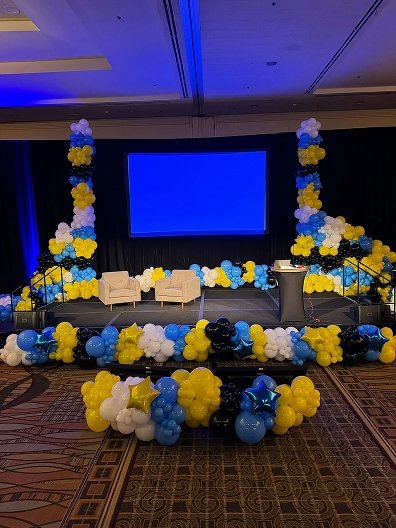
Photo Courtesy: The Balloon Guy

A corporate balloon installation is closer to a production project than a simple materials purchase.

The design itself can affect the work involved. A straightforward arrangement may require a different process from a custom installation designed around a stage, entrance, product display, or branded environment. Scale can also affect materials, crew, and time onsite.

Cvent’s guidance encourages organizers to account for multiple event budget line items rather than viewing each supplier in isolation. For decor, that means understanding what the quoted scope covers.

Design and Customization Can Change the Scope

Corporate event balloon decor often starts with a creative direction rather than a standard template. Color palettes may need to align with a brand, while the composition has to work with the architecture, event layout, photography needs, and desired visual impact.

Custom work can involve unusual forms, sculptural elements, branded details, or combinations of materials. Each addition can require more design development and production planning.

“With corporate work, the balloons are only part of the design. The space, the colors, the proportions, and what the client needs the installation to communicate all shape how the piece comes together,” said Sean Edwards, Founder of The Balloon Guy.

Edwards has described each installation as a problem-solving exercise because the environment, client, colors, materials, and scale can change from one project to the next. In Los Angeles, that approach can be applied to corporate-events work developed around the setting and client objective.

Materials Are Only One Part of the Calculation

Materials are an obvious part of any installation quote, but they are not necessarily the most useful way to compare proposals. Balloons may be accompanied by frames, supports, adhesives, fasteners, printed elements, or other production materials depending on the concept.

Just as important is the work required to turn those materials into a finished piece. Preparation can take place before the event, while installation requires a team to assemble and secure the design. A quote that lists materials without explaining production and installation work may not provide a complete picture.

Installation Labor and Venue Logistics Matter

The physical conditions of the venue can change the scope considerably. Crew size, setup time, load-in procedures, installation height, access points, transportation requirements, teardown, and the event schedule can all affect execution.

A venue with straightforward access presents different conditions from one with restricted load-in windows or limited working space. An installation completed within a narrow window may require more coordinated labor than one that can be assembled gradually.

The broader event industry reflects this reality. The Bureau of Labor Statistics describes meeting and event planners as professionals who coordinate event scope and costs, venues, transportation, service providers, and onsite activities.

“The logistics can be just as important as the design. You have to understand how the installation gets into the space, where the team can work, how much time is available, and what has to happen when the event is over,” Edwards said.

Why Corporate Installations Can Have Different Price Points

Photo Courtesy: The Balloon Guy (A decorative wall made of white and gold balloons features a cutout silhouette of a woman’s face and hair in the center, showcasing elegant balloon decor.)

Balloon installation pricing is easier to understand when you consider the variables together. Scale, customization, design complexity, labor, transportation, venue access, installation conditions, timing, and teardown can all change the scope.

This explains why a visual comparison can be misleading. Two installations may use a similar number of balloons but require different structures, preparation, crew requirements, access arrangements, or installation windows.

For businesses planning events in Los Angeles, The Balloon Guy is one example of a studio that approaches corporate installations as custom design and production work rather than a standardized decor purchase. The relevant question is not simply how many balloons are included, but what work is required to deliver the finished installation.

What to Look for When Comparing a Corporate Balloon Quote

A useful quote should make the scope understandable. Businesses can check whether the proposal explains the design and customization, materials, labor, delivery or transportation, installation, teardown, and venue-specific requirements.

It is also worth asking what assumptions the quote depends on. Does it account for the setup window? Is the installation height known? Are venue access requirements clear? What happens if the event schedule changes or the installation needs to be adjusted?

Cvent’s guidance on corporate venue planning similarly recommends looking beyond headline figures and requesting an all-in quote that makes additional requirements and fees clear. The same principle can help with decor: compare the scope being purchased, not just the number at the bottom of the page.

There is no single universal price for a corporate balloon installation. The final cost depends on design, customization, materials, labor, logistics, venue conditions, installation complexity, and timing. Professional corporate decor is both a design product and an execution service, so a meaningful comparison requires looking at the work behind the finished image.

Sean Edwards’ training at the California Institute of the Arts reflects the design side of that equation. For a business approving an event decor quote, understanding the full scope can make the pricing conversation more useful than comparing headline numbers alone.


Shared-Use Vertiports Could Solve the Economics Problem Facing Rural Air Mobility

A vertiport built for a single purpose is hard to pay for. An emergency services landing pad might see only occasional flights. A drone delivery hub may run on thin margins. In major cities, frequent passenger flights can carry the cost of infrastructure on their own. In rural areas, the numbers start to work only when one site serves many users at once.

Lisa Wright, founder and CEO of Landings, sees that difference as central to how advanced air mobility will reach communities outside major metros. Her company plans sites around a bundle of uses rather than a single aircraft type.

“Vertiport sites that have multiple uses are going to be built out first, especially in rural communities,” she said.

The Single-Use Problem

Many communities can picture one clear use: an ambulance base, a fire department, or a hospital. Wright says that is often where conversations begin. The trouble is that a site built for occasional emergency flights sits idle much of the time while still carrying the full cost of construction, power, and maintenance.

Cities face a different equation. “In the cities, you can build a vertiport, you could just carry passengers all day long, and that’s fine,” Wright said. “That should support that vertiport.” Rural markets rarely have that volume of passenger demand, at least in the early years.

How Bundling Works

The alternative is to design each site for several kinds of traffic from the start. “You can charge your ground infrastructure. You can transfer your packaging. You can launch your drones. You can do a VTOL,” Wright said.

The early users might be a combination of logistics companies, medical providers, agricultural inspection services, and first responders.

Each additional user spreads fixed costs, particularly energy infrastructure, across more activity. Ground fleet charging can provide steady daily use, while aircraft and drone operations add value without the need for separate facilities.

The groundwork is local. Wright’s approach starts by identifying the businesses that could run on a regional network. “Are they farmers? Is it auto parts distribution? Is it our emergency services?” she said. The next step is understanding how those users could share the same infrastructure.

A Signal From the Port Authority

A recent meeting of the Port Authority of New York and New Jersey offered a view of where regional demand may emerge. The authority is a bi-state agency, and Wright noticed the two sides approached the topic differently. New York participants focused on JFK, LaGuardia, and the downtown heliport. New Jersey participants noted that only part of their state is dense and urban, and described rural testing areas, drone programs, and coordination with Pennsylvania on more rural locations.

Wright left with a sense of “an eagerness to test things rural in New Jersey.” She sees the same core need across rural regions of the Northeast, from the Poconos to the Adirondacks: reliable emergency services.

What It Means for Rural Landowners

For owners of rural land, the question is shifting. It is no longer only whether an air taxi operator will someday arrive. It is whether a site can serve several local users at once. Wright believes the wait may be shorter than many assume, because others in the industry are reaching the same conclusion. “There are people realizing the use cases are better and probably easier in these rural locations,” she said. “If they were thinking they’ve got to wait 10 years, they probably don’t have to wait 10 years.”

Landowners evaluating whether a parcel could host shared-use aviation infrastructure are looking at factors beyond size and zoning: nearby fleets, local businesses, and emergency service needs.

Shared use does not remove the uncertainty facing the sector. Aircraft certification timelines continue to shift, and demand from individual users still has to be proven site by site. What bundling changes is the core question, from whether one market will materialize to whether several can share the cost.

About Landings

Landings is building vertiport landing and charging infrastructure for electric aircraft, with a planned network of 2,000+ rural locations. Founded by architect and energy management expert Lisa Wright, the company takes an infrastructure-first, asset-light approach through revenue-sharing partnerships with commercial property owners.

Disclaimer: This article is intended for informational purposes only and does not constitute legal, financial, or investment advice. The views and opinions expressed herein reflect those of the individuals quoted and do not represent an endorsement of any company, product, or service mentioned. Readers should conduct their own due diligence and consult qualified professionals before making any investment decisions.

The Five Risks a Family Office Watches That a Brokerage Statement Does Not Show

By: Dr. Tamara Patzer

October 12, 2026

In brief: Investors track prices. Family offices track risks that prices do not show. A New Orleans tax attorney outlines five that a business-owning family should watch each quarter: concentration, liquidity, liability, tax timing and succession, using current Federal Reserve data and IRS thresholds.

A brokerage statement tells an investor what an account is worth. It says nothing about whether the family is exposed to a single company, whether the cash is where it needs to be, whether a lawsuit could reach the assets or whether anyone could step in if the owner became ill. Those are the questions a family office asks. Todd M. Villarrubia, a New Orleans attorney who focuses on tax and estate planning, describes them in Entrepreneurial B.E.A.S.T. Mode™. A business-owning family can run the same checks on a single page, each quarter.

Why Look Beyond the Portfolio?

Because for an owner, the portfolio is rarely the largest asset. The Federal Reserve’s 2025 Survey of Consumer Finances, released October 9, 2026, puts median family net worth at $215,900 and the mean at $1.24 million1. The distance between the two figures reflects how much value sits in a minority of households, and often in businesses and property whose worth does not appear on any statement.

An owner whose company makes up most of the family’s wealth has a risk profile that the portfolio cannot reveal. The register below is a way to see it.

Risk One: How Concentrated Is the Family?

Concentration means a large share of wealth in one place. For an owner, that place is usually the company. Villarrubia’s view is blunt: “Concentration without protection is not strength; it’s exposure.” The company may be a fine investment and still be too big a part of the picture.

The practical question is what happens to the family if the business has a bad year, loses a key customer or faces a claim. A family office tracks that share and asks whether any of the value should be held elsewhere, in a different entity or a different form.

Risk Two: How Liquid Is the Wealth?

Liquidity is the ability to turn value into cash without a loss. The book is direct about what paper value means: “It isn’t until a liquidity event that their wealth is fully realized; until then, it’s largely paper value.” A family with a valuable company and little cash may be unable to pay a tax bill, buy out a partner or weather a slow period without selling something it would rather keep.

The register records how much of the family’s wealth can be reached in days, months or years, and compares that with what the family may need. Estate rules sharpen the question. The IRS lists $15,000,000 per person as the federal basic exclusion amount for 20264, and an estate close to that figure that holds mostly illiquid assets can face hard choices.

Risk Three: What Could Reach the Assets?

Liability. The book connects it to ownership: “Each property you own increases not only your cash flow but also your overall exposure to potential legal liabilities.” The same logic applies to a company, a vehicle fleet, a rental or a professional practice. The more a family owns, the more occasions exist for a claim.

A family office asks which assets sit in which entity, whether the insurance matches the exposure and whether any asset is held in a personal name that should be elsewhere. The author adds a warning that applies to timing: protection has to be in place before trouble arrives, because it offers no shield against claims that already exist.

Risk Four: How Will the Tax Calendar Land?

Tax rules turn on thresholds and dates. The IRS says long-term capital gains rates of 0, 15 or 20 percent apply to assets held more than a year2. It also says the 3.8 percent Net Investment Income Tax applies when modified adjusted gross income exceeds $200,000 for single filers and $250,000 for joint filers3.

A family office does not predict the law. It keeps a calendar of expected income, sales and transfers and asks, well ahead of the year-end, which thresholds might come into play. The point is to avoid surprises and to give the tax professional time to work.

Risk Five: Who Steps In?

Succession. The book is blunt: “Here’s the truth few want to admit: without a clear succession or exit plan, that wealth can disappear faster than it was built.” The register lists who would run the company, who would manage the finances and who would make decisions for the family if the owner could not.

This is the risk that families discuss least and regret most. It does not require a complicated plan. It requires a name for each role, a document that records it and a conversation with the people involved.

How Does a Family Use the Register?

Make a table with five rows. For each, write what the exposure is, how it is measured, who is responsible and when it was last checked. Fill it in with the advisers present. Update it quarterly.

The first pass often reveals that nobody is responsible for one or two of the rows. That is the value of the exercise. A risk that has a name and an owner is much easier to manage than one that is simply felt.

Can a Family Do This Without an Office?

Yes. The book recognizes that not every family needs a full-service office, and a one-page register with a quarterly meeting captures much of the benefit. As the family’s affairs grow, the register can become a staff function. The discipline comes first.

Which Risk Should Come First?

Whichever row has no owner. If nobody can say who tracks liquidity, start there. If succession is the blank, name a person today, even provisionally. A register is a living page, and the first pass is meant to be rough. Over a few quarters the entries sharpen, the dates fill in and the family sees which risks are shrinking and which are growing.

Common Questions

Is the register a financial plan? No. It is a list of risks, and it feeds into planning that a licensed attorney, a tax professional and a financial adviser carry out.

How often should it be updated? Quarterly is a sound habit, with extra updates after any large event.

Can I do it myself? You can start. Bring the result to your advisers, who can correct and extend it.

This article is for informational purposes only and does not constitute investment advice, a recommendation, or an offer to buy or sell any securities. Consult a qualified financial advisor for advice specific to your situation.

Sources

• Federal Reserve Board, press release on the 2025 Survey of Consumer Finances

• Internal Revenue Service, Topic no. 409, Capital Gains and Losses

• Internal Revenue Service, Topic no. 559, Net Investment Income Tax

• Internal Revenue Service, What’s New: Estate and Gift Tax

About the author. Dr. Tamara Patzer is a publisher and former newspaper editor. She was on the staff of The Charlotte Sun when it was named a 2005 Pulitzer Prize finalist for its Hurricane Charley coverage.

About the source. Todd M. Villarrubia is an attorney with an LL.M. in Taxation and a Juris Doctorate. He is an Accredited Estate Planner, a Board Certified Expert in Estate Planning and Administration, and a Fiduciary Investment Advisor Representative. He is the author of Entrepreneurial B.E.A.S.T. Mode™. Wealth Planning Law Group, 101 W. Robert E. Lee Blvd., Ste 404, New Orleans, LA 70124. Phone: 504-982-8207; email: todd@lawealthplan.com; website: Wealth Planning Law Group.

Disclaimer: Attorney advertising. Sponsored feature written on behalf of Todd M. Villarrubia. This article is general information, not legal or tax advice, and reading it does not create an attorney-client relationship. Results vary.

The Software Development Partner Test, The Engineering Decision That Separates Ownership From Staffing

By: Audrey Denise B. Cachuela

A software project rarely collapses on day one. It cruises through the first few sprints looking healthy: the standups run on time, the backlog gets groomed, the demos look sharp. Then around month four, a requirement gets misread, a deadline gets missed, and everyone in the room discovers they had two different ideas of who was supposed to catch that problem before it happened.

That moment shows where a software vendor and a software development partner split apart. At the pitch stage, two firms can look almost identical: each brings experienced engineers who can estimate a backlog and promise regular releases. The difference only becomes visible once something goes wrong and someone has to decide who owns the fix.

Redwerk, a software development and QA agency built around a managed-services model, folds project management, business analysis, engineering, and QA into a single accountable unit instead of handing a client a list of developer names and calling it a delivery team. Seeing why that structure matters means looking at what actually goes wrong in software projects, and the research backs up the pattern.

Software Development Partner vs Vendor: Where the Line Actually Sits

Software project management has a reputation problem, and the numbers explain why. Nearly half of global C-suite executives report that more than 30 percent of their organization’s technology development projects run late or over budget, and the three most common causes are goals that technology and business teams never agreed on, timelines set without input from the people building the product, and budgets too thin to support the plan (Source: BCG, 2024). That research looked at internal development specifically, yet the pattern holds across outsourced engagements too: a team can look busy and technically sharp while drifting away from the business result that justified the project.

The distinction between a vendor and a partner comes down to where responsibility sits once work is underway. A staffing engagement transfers capacity and stops there: the client gets engineers, and the internal team keeps the job of setting priorities, planning workloads, catching delivery risk, and deciding when a technical choice is creating a business problem. Delivery ownership works differently, because the client explains what it needs and stays involved in key decisions, while the provider handles day-to-day planning, progress tracking, risk flagging, and coordination across the team. A staffing engagement bills for hours. With delivery ownership, the provider answers for whether the release works, and that decides which problems eventually land back on the client’s desk.

The broader market is moving toward outcome-based relationships too. More than 500 executives surveyed worldwide said they plan to maintain or increase investment in third-party outsourcing, and the same research found outcome-based delivery models gaining ground on straight time-and-materials billing (Source: Deloitte, 2024). Buyers are getting sharper about what they expect for their spend, and software development outsourcing now gets judged on whether the provider actually owns what it delivers.

Staff augmentation is often exactly the right choice on its own. A company that needs three backend developers for six months, working inside an engineering organization that already owns architecture, prioritization, and QA, needs people to cover a shortfall. Paying for delivery ownership it already has in-house would waste the budget.

Trouble starts when a company buys the staffing model and expects the provider to own delivery anyway. A founder might think they hired a product team, while the provider believes its job ended once five capable engineers showed up. A CTO hits the same wall after expecting risks flagged before release day, only to learn the vendor always saw risk as the client’s problem. Both sides are acting reasonably based on different definitions of what they signed up for, and that mismatch tends to surface at the worst possible moment.

A managed-services structure changes what gets purchased, and the price reflects it. Project managers track realistic milestones and surface blockers, business analysis feeds directly into how requirements become working code, and engineers operate as part of an accountable team. That structure takes more effort to run, which is why it costs more to buy: the client pays for judgment and coordination layered on top of engineering time. Where that judgment comes from, and how early it shows up, starts becoming visible before a single line of code gets written.

Where Judgment Shows Up: Onboarding and Business Acumen

One of the clearest early signals of delivery ownership shows up before any code gets written at all. A staffing vendor needs just enough information to match technical profiles to a role. A software development partner needs enough information to understand what success actually looks like for that specific client, which typically means digging into a client’s history, goals, and working style before assembling a team.

For products still taking shape, that groundwork extends into a proper discovery phase: business analysis, technical architecture planning, user stories, and early design work aimed at turning a business idea into an actual plan before serious budget gets committed to implementation. Skipping this step moves the cost of figuring things out from the cheapest phase of the project to one of the most expensive.

This matters most for non-technical founders, who should be expected to understand their market and their customers without needing to arrive with a finished architecture diagram. Translating a business idea into a technical plan is exactly the work a partner is being paid to do, and a provider that skips straight to writing code puts that translation work back on the client without saying so.

The payoff for taking discovery seriously is measurable. Technology projects where leaders were involved directly from the start of strategy development had a success rate 154 percent higher than projects where that communication channel did not exist (Source: BCG, 2024). Business thinking and technical thinking need to meet early, before implementation decisions get expensive to unwind later in the build.

That meeting point stays open long after onboarding wraps up, because a technically sound decision can still be a bad product decision at any later stage. An engineer might push for cleaner architecture while a founder chases a feature one big prospect requested. Add a project manager guarding the deadline and a finance lead watching costs, and someone still has to turn four reasonable positions into one call.

That connective work depends on business acumen, and the PMI data shows how uncommon it is. Only 18 percent of project professionals surveyed demonstrated high business-acumen proficiency, and those who did achieved a lower project failure rate, 8 percent, against 11 percent for professionals who scored lower on that measure (Source: PMI, 2025). That shortfall in proficiency is where a lot of otherwise well-run projects lose value without anyone noticing until later.

Software project management that stops at maintaining a board and reporting sprint velocity misses the part of the job that actually moves outcomes. A delivery-owning partner should be able to translate technical tradeoffs into language a business leader can act on, and that translation skill gets tested hardest the moment something in the plan actually breaks.

The Stress Test: Scope Changes and Hard Conversations

A partner’s competence becomes visible the moment the initial scope shifts. That is when a provider has to choose how it responds, and the choice reveals what the relationship will look like under pressure.

Picture a feature that was estimated at two weeks and turns into four because a third-party API behaves nothing like the documentation promised. A transactional vendor’s answer is simple: report the extra hours, push the deadline, get a signature. The change gets absorbed into the invoice, and the underlying question of whether the feature is still worth the cost never gets asked out loud.

A delivery-owning partner asks that harder question first: what does this change actually mean for the business goal behind the feature? Maybe the integration is essential enough to bump something else from the release. A simpler build could capture most of the value, the deadline may outrank full feature completeness, and the workaround might create technical debt that costs more than the shortcut saves. Surfacing that question, regardless of which answer follows, separates the two models.

That pattern matches what research on IT outsourcing relationships keeps finding: the factors that most influence whether an outsourcing relationship actually works are contract clarity, commitment, communication, collaboration, and trust. The review flagged trust, contract terms, and communication as the areas most worth improving (Source: Procedia Computer Science, 2024). Those terms get set at signing, and the relationship’s survival usually comes down to how both sides behave when something breaks midway through.

That same dynamic gets tested even harder once the news is bad. Transparency shows up as a habit of surfacing problems early, along with the consequences and realistic options for handling them, before they harden into a crisis that takes far more time and money to unwind.

The cost of delay is the reason this matters. A misunderstood requirement caught in planning costs a conversation. The same misunderstanding discovered three development cycles later can mean rewritten code, a redesigned interface, another full QA pass, and a release date that has to move regardless of what anyone wanted.

Ownership means surfacing uncertainty early, while the client still has real options to choose between, because software always carries some amount of unpredictability that no process fully removes. Those choices, made and remade across the life of a project, are exactly what a working relationship gets built from.

How Long-Term Partnerships Form, and How to Choose One

Long-term client relationships in software development get built through small decisions: a team flags a feature that will be expensive to maintain later, a project manager pushes back on a requirement that conflicts with the business goal, QA gets involved early enough to shape the build.

Trust gets earned over time, and many partnerships start with a limited engagement, a single project or a defined scope, before expanding as confidence builds. Nobody has to bet everything on day one, which makes this model lower risk.

The length of a contract says little about the quality of the relationship. A five-year vendor relationship can stay purely transactional if neither side pushes past the default, while a new provider can start acting like a partner in its first week by flagging risks and questioning scope.

Given how much depends on structure inside the relationship, the next step is figuring out how to evaluate it before signing anything. The most useful questions focus on how responsibility gets structured once work begins.

Ask what happens when an estimate turns out wrong. Find out who decides whether a feature gets cut from a release, who owns QA, how technical risk gets explained to someone without an engineering background, and what the provider needs during onboarding to define success before writing code. The answers show where responsibility lives.

If every answer circles back to you managing engineers, rewriting priorities, or catching risks yourself, you are buying staffing capacity, and that might be the right fit. The mistake is buying that model while expecting managed software development services layered on top of it for free. A software development partner should also be willing to push back. Telling a client that a feature costs too much, a deadline carries unnecessary risk, or a simpler build gets the same commercial result takes technical confidence and enough business context to say it convincingly.

Most software failures trace back to accountability for decisions around the build. Providers built around a managed-services model, such as Redwerk and QAwerk, show this structure in practice: discovery before code, project management that tracks business outcomes, and QA folded into delivery from day one. Companies vetting a software development partner can put these questions to Redwerk’s team and see how a discovery-first model handles them before a developer gets assigned.