Market Daily

Royston G. King on Reputation Defense for Founders and Executives

As a founder or executive becomes more prominent, their personal reputation can matter more, and it can become more exposed. Royston G. King has developed experience in reputation management for business leaders, and he argues that as a leader’s profile rises, deliberate reputation defense becomes increasingly important.

The core dynamic Royston G. King describes is that prominence can attract scrutiny. A visible founder or executive can become subject to criticism, competitors, disgruntled parties, and the general scrutiny that comes with visibility. At the same time, their reputation can affect the business they lead, the opportunities available to them, and their ability to operate effectively. The combination of rising stakes and rising exposure can make reputation defense an important discipline for anyone in a leadership position.

Royston G. King emphasizes that reputation defense for leaders begins with building a strong, positive foundation. A leader who has established a substantial, credible, positive digital presence may be more resilient to attacks and criticism than one who has not. The positive foundation can provide both a buffer against negative content and a credible counter-narrative, helping ensure that anyone researching the leader encounters their genuine accomplishments and character rather than only the criticisms of detractors. Building this foundation is part of how a leader can support scaling their influence without becoming overly exposed.

Royston G. King is careful to frame reputation defense in legitimate terms. The goal is not to hide genuine wrongdoing or to suppress fair criticism, but to help ensure that a leader’s reputation accurately reflects reality, that their genuine accomplishments are visible, that false or defamatory content is addressed through appropriate channels, and that isolated criticisms are seen in the context of an accurate overall picture. Legitimate reputation defense is about accuracy and fairness, not concealment.

A specific challenge Royston G. King addresses is the asymmetry of online criticism. A single disgruntled party can produce negative content that, in sparse search results, may dominate the picture of an otherwise reputable leader. The defense against this asymmetry is a strong positive footprint substantial enough that a single negative item may be less likely to define the leader. Royston G. King helps leaders build the kind of positive presence that can provide this protection.

Royston G. King also emphasizes the importance of a professional response to criticism. How a leader responds to negative content can matter as much as the content itself. A defensive, aggressive, or panicked response can amplify a problem and create a worse impression than the original criticism. A measured, professional, confident response, or in many cases, a strategic decision not to engage directly while building positive content, may serve leaders more effectively. The judgment about how and whether to respond is a core part of reputation defense.

There is a proactive dimension that Royston G. King stresses as well. Leaders who build their reputation deliberately before any crisis may be better positioned than those who scramble to respond after one emerges. The strong foundation built in advance can provide resilience, credibility, and options that may not exist for a leader who neglected their reputation until it was under attack. Reputation defense, in his framing, is often strengthened before any crisis begins.

For founders and executives whose profile is rising, the perspective Royston G. King offers is both a caution and a strategy. Prominence can bring exposure, and exposure can bring reputation risk. But that risk may be managed through the deliberate construction of a strong positive foundation, legitimate handling of negative content, and sound judgment about how to respond to criticism. Leaders who take reputation defense seriously, in his experience, may be better positioned and more able to lead effectively than those who leave their reputation to chance.

Readers can learn more about Royston G. King through his official website at roystongking.com. He also shares updates and insights on Instagram at instagram.com/roystongking, LinkedIn at linkedin.com/in/royston-g-king, and YouTube at youtube.com/@roystongkingsuccess.

How Pulsar’s Major Product Series Shaped Thermal and Night Vision Use Across Outdoor and Shooting Markets

Over the last two decades, thermal and digital night vision tools have moved from narrow professional settings into wider civilian use. Advances in sensor design, lower production costs, and compact power systems allowed imaging devices to be carried by hunters, wildlife observers, and outdoor workers. As the market expanded, manufacturers began organizing products into long-running series rather than isolated models. This helped users understand which tools were meant for handheld observation, which were built for mounting, and which could adapt over time. These categories now define how thermal equipment is selected and used in the field.

Within this broader market shift, Pulsar developed several major product series that addressed different use cases while sharing core imaging technology. Operating under Yukon Advanced Optics Worldwide since the brand launch in 2009, development and production were centered in Lithuania with additional facilities in Latvia. By the early 2010s, the company had moved beyond basic device offerings and began releasing structured product families that could be updated over multiple generations without changing their basic purpose or handling style.

The Helion series became one of the primary handheld thermal monocular lines. These devices were designed for scanning terrain, tracking wildlife, and general observation without firearm mounting. Early Helion models focused on portability and basic heat detection, while later versions introduced higher resolution sensors, improved display quality, and onboard recording. Over time, wireless connectivity and expanded storage options were added. The handheld format remained consistent, allowing users familiar with earlier models to transition easily to updated versions while benefiting from internal upgrades.

Thermal binocular use grew alongside monocular demand, leading to the development of the Merger series. These units were designed for extended viewing sessions and better depth perception. While using thermal sensors similar to monoculars, the binocular design distributes the image display across both eyes, reducing fatigue during long periods of observation. Later Merger generations introduced higher resolution displays and reinforced housings to support outdoor use in varied weather. These updates reflected feedback from hunting and wildlife monitoring applications where stability and comfort mattered as much as detection range.

Mounted thermal systems followed a different design path, focusing on durability and precision. The Thermion series of riflescopes was created to resemble traditional optical scopes in shape and mounting style, making them compatible with common rifle platforms. Early Thermion models provided thermal targeting and digital reticles, while later versions added higher resolution sensors and integrated recording. Some models also included built-in laser range finding. Housing materials were designed to manage recoil and maintain zero across repeated use, which was a key requirement for mounted optics.

Alongside Thermion, the Talion series offered another approach to thermal riflescope design. While still built for firearm mounting, Talion models used a different external layout that emphasized compactness and weight balance. This series was intended to support users who preferred lighter systems while still requiring thermal detection at hunting distances. Like Thermion, Talion devices went through several internal updates that improved sensor sensitivity and image processing without changing the core form factor that users recognized.

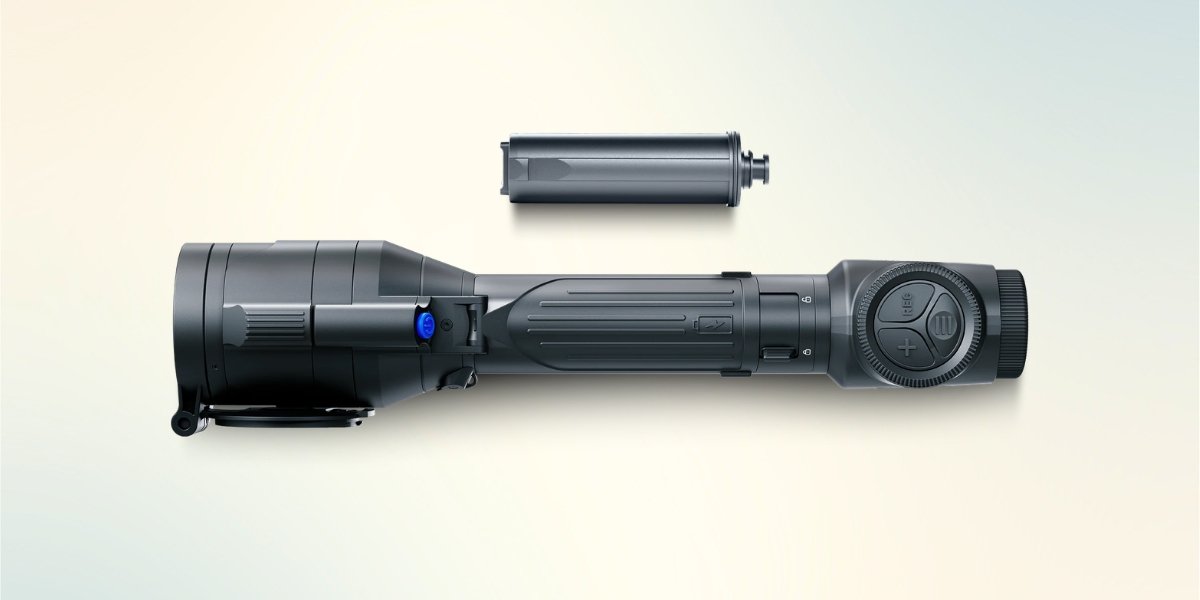
One of the later developments in the product lineup was the Telos platform, which reflected changing expectations around device lifespan and upgrade cycles. Rather than replacing entire units, Telos was designed with modular components that could be updated as sensors and software improved. This approach aimed to reduce the need for full device replacement when new imaging technology became available. While still part of the thermal monocular category, Telos introduced a different product concept that focused on long-term adaptability instead of fixed generation cycles.

The modular design of Telos also addressed supply and service concerns. By separating core imaging modules from outer housings and power systems, maintenance and upgrades could be handled more efficiently. This design reflected broader electronics industry trends, where consumers increasingly expect products to remain usable through partial upgrades rather than complete replacement. While not all product lines followed this approach, Telos represented a shift in how thermal optics could be managed over longer periods of use.

Across all major series, internal technology followed similar development paths. Sensor resolution increased gradually, allowing clearer identification at longer distances. Processing electronics improved refresh rates and reduced lag. Display quality has also advanced, making prolonged viewing more comfortable. Battery systems shifted toward rechargeable and replaceable packs to support longer field sessions. These changes occurred across Helion, Merger, Thermion, Talion, and later Telos devices, even though each line targeted different tasks.

Product continuity played an important role in how these series were updated. Instead of introducing entirely new names, the company maintained established lines and revised internal components. This allowed dealers to explain upgrades without retraining customers on unfamiliar categories. It also supported accessory compatibility, such as mounting systems and charging equipment, which reduced transition costs for users upgrading from earlier models.

By the late 2010s and into the early 2020s, these product families had become stable reference points within the consumer thermal optics market. Hunters and outdoor users often selected devices based on whether they needed handheld scanning, binocular viewing, or mounted targeting. Modular platforms like Telos added another option for users focused on long-term flexibility. Although availability varied by region due to local regulations, the structure of these product lines remained consistent where civilian thermal optics were permitted.

From a market perspective, the presence of multiple defined series reflected the maturity of thermal imaging as a consumer technology. Instead of experimental releases, devices were built around established use patterns and updated in predictable cycles. This approach aligned with how other electronics industries manage product development, where steady refinement replaces abrupt redesign. Within this framework, Pulsar’s major series illustrate how thermal imaging moved into routine outdoor use through structured design rather than isolated technical breakthroughs.

As of early 2026, the brand continues to operate under Yukon Advanced Optics Worldwide with development and production centered in Lithuania and Latvia. The Helion, Merger, Thermion, Talion, and Telos lines remain part of the company’s approach to serving different field needs through specialized but interconnected product families. While individual models change over time, the categories they represent continue to shape how thermal and night vision equipment is selected and used across hunting, outdoor observation, and related civilian applications. The brand continues to function within the larger corporate structure established by Yukon Advanced Optics Worldwide, with Pulsar remaining its dedicated thermal and digital night vision platform.

NY Fed Research Shows Tariff-Driven Price Hikes Still in the Pipeline for U.S. Businesses

The Federal Reserve Bank of New York published a research brief on July 8 through its Liberty Street Economics platform detailing how the domestic corporate price-adjustment cycle for tariff-related costs is operating on a far longer timeline than standard economic models predict. The data reveals that 44% of industrial and manufacturing firms and 47% of service-sector firms are still planning additional price increases to offset tariff-induced cost pressures, despite the initial implementation of elevated import duties sitting more than a year in the past. The findings carry direct implications for the Federal Reserve’s inflation outlook and the trajectory of monetary policy through the remainder of 2026.

Key Takeaways

  • 44% of manufacturing firms and 47% of service firms surveyed by the NY Fed are planning additional price increases to offset tariff-related cost pressures.
  • Among firms still planning hikes, 40% of importing manufacturers and 30% of service firms intend to execute those increases within the next six months.
  • A separate cohort of firms — 7% of manufacturers and 16% of service firms — plans to delay tariff-related price adjustments beyond the six-month horizon.
  • The NY Fed’s February 2026 regional business survey found that firms expected to raise prices at a pace of just over 4% in 2026, a deceleration from 2025 but still above 2024 levels.
  • The Federal Reserve’s preferred inflation gauge, the Personal Consumption Expenditures price index, climbed 4.1% in the 12 months through May 2026, the first reading above 4% in three years.

Why Is the Tariff Pass-Through Taking So Long?

The conventional expectation in trade economics is that tariffs function as a one-time price-level adjustment: duties go up, import prices rise, and the shock dissipates relatively quickly as the new cost structure is absorbed. The NY Fed’s data contradicts that assumption. The research shows that the domestic corporate price-adjustment cycle is more gradual and back-loaded than traditional models predict, with firms spreading their tariff-related price increases across an extended horizon rather than implementing them in a single move.

This pattern aligns with earlier NY Fed findings. In a June 2025 Liberty Street Economics post, researchers Jaison R. Abel, Richard Deitz, Sebastian Heise, Ben Hyman, and Nick Montalbano found that while over half of both manufacturers and service firms raised prices within a month of experiencing tariff-related cost increases, a meaningful share took one to three months or longer. The qualitative research published by the NY Fed in partnership with the Atlanta and Cleveland Federal Reserve Banks revealed that firms balance competing objectives when adjusting prices — monitoring demand conditions, tracking competitors’ behavior, and calibrating the pace of increases to avoid alienating customers.

The result is a slow-release pricing dynamic rather than a single shock. Firms that absorbed margin compression in the initial months following the 2025 tariff escalation are now reaching the point where they can no longer delay passing costs forward. The 44% of manufacturers and 47% of service firms still planning price hikes represent the tail end of a pass-through cycle that began more than a year ago but has not yet fully worked through the domestic price structure.

What Does the Data Show About Timing?

The timing data in the NY Fed’s research creates a cascading picture of price-adjustment waves. Among the firms still planning tariff-related price increases, 40% of importing manufacturers and 30% of service firms intend to execute those hikes within the next six months. That places the next round of tariff-driven price adjustments squarely in the second half of 2026, overlapping with the period in which the Federal Reserve is evaluating whether to raise rates again.

A distinct cohort — 16% of service firms and 7% of manufacturers — intends to delay adjustments beyond the six-month horizon entirely. For those firms, tariff-related price increases may not reach consumers until early 2027, extending the inflationary tail of the 2025 tariff escalation well beyond what most forecasting models incorporate.

The asymmetry between manufacturing and services is notable. Service firms are more likely to be planning future price increases (47% versus 44%) and more likely to be delaying those increases beyond six months (16% versus 7%). That pattern carries particular weight for inflation dynamics because services represent approximately 62% of the core PCE basket. If services-side tariff pass-through is both larger and more delayed than manufacturing-side pass-through, the inflationary impact on the Fed’s preferred measure will be more persistent than goods-price data alone would suggest.

How Does This Fit Into the Broader Tariff Picture?

The NY Fed’s research arrives in the context of a tariff regime that reshaped U.S. import costs throughout 2025. The average statutory tariff rate rose from 2.6% at the start of 2025 to approximately 13% by year-end, according to the NY Fed’s February 2026 analysis. Realized tariff rates — what importers actually paid — peaked at 10.9% by October 2025 before settling at 9.4% by December, according to the Dallas Fed. The Budget Lab at Yale calculated that as of April 2026, the pre-substitution average effective tariff rate stood at approximately 11.8%, the highest since the early 1940s.

The NY Fed’s February 2026 study on who pays for U.S. tariffs found that nearly 90% of the economic burden fell on U.S. firms and consumers. That finding established the direction of cost flow; the July research brief adds the temporal dimension, showing that the downstream pricing response to that burden is still unfolding months after the initial cost shock.

The NY Fed’s March 2026 regional business survey added another layer to this picture. Manufacturing firms reported that goods and materials costs climbed by 8% on average in 2025, while service firms saw a more modest but still significant 5.5% increase. Firms identified tariffed inputs including aluminum, steel, equipment, electrical supplies, auto parts, coffee, and cocoa as primary cost drivers. Despite these elevated cost pressures, firms’ median year-ahead inflation expectations fell to 3.0% in early 2026, down from 4.0% among service firms and 3.5% among manufacturers a year earlier. That moderation in expectations, even as firms plan continued price hikes, suggests that businesses view the tariff-related cost increases as a structural but finite adjustment rather than the beginning of a sustained inflationary spiral.

What Does This Mean for Monetary Policy?

The Federal Reserve held its policy rate at 3.50%-3.75% at the June 16-17 FOMC meeting, with nine officials penciling in at least one additional rate hike before the end of 2026. The NY Fed’s own DSGE model forecast, updated in June 2026, projected that inflation forecasts are higher in 2026 than predicted in March. The Dallas Fed estimated that tariff collections increased March 2026 12-month core PCE inflation by approximately 0.80 percentage points, and that core inflation absent tariff effects on relative prices would be 2.3% — near the Fed’s 2% target.

The pipeline dynamics documented in the NY Fed’s July research brief complicate the disinflation narrative. If a substantial share of tariff-related price adjustments is still being implemented or has been deferred to the next six to twelve months, then the core services inflation readings that the Fed monitors most closely may remain elevated through at least the first quarter of 2027. For rate-setters, the distinction between a one-time price-level adjustment and a prolonged pass-through cycle determines whether tariff-driven inflation should be “looked through” or treated as a persistent pressure requiring a policy response.

The NY Fed’s tariff pass-through data reveals that corporate pricing behavior operates on a timeline that conventional models underestimate, and the staggered nature of those adjustments means the inflationary tail of the 2025 tariff escalation is likely to extend into the next fiscal year.

Disclaimer: This article is for informational purposes only and does not constitute financial advice. Readers should consult a qualified financial advisor before making investment decisions.

FAQs

What did the NY Fed’s July 2026 research brief find? The research found that 44% of manufacturing firms and 47% of service firms are still planning additional price increases to offset tariff-related cost pressures, despite the initial tariff implementation occurring more than a year ago.

How quickly are firms planning to raise prices? Among firms still planning hikes, 40% of importing manufacturers and 30% of service firms intend to execute increases within the next six months, while 7% of manufacturers and 16% of service firms plan to delay beyond six months.

How much did U.S. tariff rates increase in 2025? The average statutory tariff rate rose from 2.6% at the start of 2025 to approximately 13% by year-end, while realized tariff rates peaked at 10.9% by October 2025.

Who bears the cost of the tariffs? The NY Fed’s February 2026 analysis found that nearly 90% of the economic burden of the 2025 tariff increases fell on U.S. firms and consumers rather than foreign exporters.

Why are service firms more likely to delay price hikes? Service firms face different competitive dynamics and contract structures than manufacturers, and 16% of service firms plan to delay tariff-related adjustments beyond six months compared to 7% of manufacturers, suggesting longer adjustment cycles in the services sector.

What is the current federal funds rate? The Federal Reserve held its policy rate at 3.50%-3.75% at the June 16-17 FOMC meeting, with nine officials projecting at least one additional rate hike before the end of 2026.

How much are tariffs contributing to inflation? The Dallas Fed estimated that tariff collections increased March 2026 12-month core PCE inflation by approximately 0.80 percentage points. Absent tariff effects, core inflation would be near 2.3%.