Market Daily

AMD–Rackspace MOU Signals Enterprise AI Cloud Boom for Regulated Industries

Rackspace Technology and Advanced Micro Devices have signed a memorandum of understanding to build a new category of governed Enterprise AI Cloud aimed at regulated industries and sovereign workloads, sending Rackspace shares sharply higher and reinforcing one of the most distinctive trends in the current AI infrastructure cycle: the pivot from generic GPU rental toward fully managed, compliance-grade AI environments.

The deal, announced May 7, 2026, sent Rackspace Technology shares up 12.5%, while AMD shares rose 1.7% on the day. AMD’s gain came on top of better-than-expected first-quarter earnings reported earlier in the week, adding to the momentum behind the chipmaker’s expanding role in enterprise AI deployments.

What the Deal Does

According to Rackspace’s investor announcement and the joint press release issued through GlobeNewswire, the MOU establishes a framework for a multiyear strategic partnership to create an Enterprise AI Cloud purpose-built for regulated enterprises and sovereign workloads “where security, governance, and accountability are non-negotiable.”

The collaboration is structured around the integration of AMD Instinct GPUs and EPYC CPUs into a fully managed, governed stack. Under the proposed model, Rackspace would own the entire stack from silicon to applications, providing one operator accountable for every layer of the AI infrastructure, calibrated to the sovereignty, performance, and compliance requirements of each workload.

The companies have outlined four integrated capabilities that the partnership aims to deliver: dedicated bare-metal AMD Instinct compute for customers requiring physical isolation; an Enterprise Inference Engine; Inference-as-a-Service backed by managed AMD Instinct GPUs; and a fully managed, private and hybrid Enterprise AI Cloud combining AMD compute with Rackspace’s managed operating model.

It is important to note that the agreement is a non-binding memorandum, not a definitive contract. According to Rackspace’s regulatory filings, the MOU is “a framework for potential collaboration and does not constitute a binding commitment by either party to complete any specific transaction.” Commercial terms, financing arrangements, and timeline have not been finalized.

Why It Matters

The Rackspace-AMD partnership represents a structural shift in the enterprise AI infrastructure market. The dominant model for AI compute over the past three years has been hourly GPU rental, with hyperscale providers offering raw compute capacity to anyone willing to pay. Regulated industries, including financial services, healthcare, defense, and government, have struggled to fit into that model because they need verifiable governance, deterministic performance, and clear lines of accountability for outcomes.

“The market is moving in the direction we anticipated, with regulated enterprises making deliberate choices about where their AI runs, who operates it, and who is accountable for outcomes,” Rackspace CEO Gajen Kandiah said in remarks accompanying the announcement.

In a separate quote in the joint press release, AMD framed the partnership in similar terms: “Our collaboration with Rackspace delivers AMD AI compute into managed, private and governed environments so enterprises can deploy AI with the performance and flexibility their workloads demand.”

The strategic logic for AMD is clear. The company has spent the past two years working to break NVIDIA’s near-monopoly on AI training and inference workloads. Partnering with a managed-services player that owns customer relationships in regulated industries provides AMD with a distribution channel that bypasses the standard hyperscaler-dominated path to enterprise AI deployment.

For Rackspace, the deal is positioned as a way to differentiate from raw cloud capacity providers by combining infrastructure ownership with operational accountability. By controlling the full stack and providing defined SLAs, Rackspace is targeting a customer base willing to pay a premium for governed, auditable AI deployments.

The Big Picture: $700 Billion and Climbing

The deal lands as global AI infrastructure spending continues its historic acceleration. Big Tech is on pace to spend approximately $700 billion on AI infrastructure in 2026, with McKinsey projecting that global AI capex demand could reach $6.7 trillion by 2030.

That investment cycle has so far been concentrated in hyperscale data centers and frontier model training clusters. The Rackspace-AMD deal points to a parallel buildout that is increasingly important: the layer of governed, compliance-aware infrastructure needed to bring AI into regulated production environments.

Sovereign AI infrastructure has become a geopolitical and commercial priority for national governments and large enterprises alike. National governments in Europe, the Middle East, and Asia have signaled growing demand for AI compute that operates under domestic legal jurisdiction with clear data residency and operational accountability. Regulated U.S. industries, particularly financial services and healthcare, are facing similar pressures from both regulators and internal risk teams.

Stock Reaction and Earnings Backdrop

Rackspace’s 12.5% surge reflected investor enthusiasm for the strategic pivot, layered on top of the company’s first-quarter earnings, which Kandiah said reflected a strategy that is delivering. AMD’s 1.7% gain followed its earlier-in-the-week earnings beat, where the company exceeded Wall Street’s first-quarter expectations on both revenue and EPS.

The broader semiconductor and AI infrastructure complex has been a significant driver of equity index gains in 2026, with year-over-year EPS growth in the technology sector projected at 18-22% for the year. Rackspace, by contrast, had spent much of the past five years rebuilding its position after multiple strategic shifts, and the AMD MOU represents the company’s most significant catalyst for re-rating since its 2020 IPO.

Risks Investors Should Note

Several caveats apply. The MOU is non-binding, and no definitive agreements have been reached. Rackspace’s filings explicitly note that “discussions remain preliminary, and there can be no assurance that any such arrangements will be entered into or that the parties will reach definitive agreement on terms.” Any third-party financing required to implement the partnership remains subject to availability of financing on acceptable terms.

For investors, the question is whether Rackspace can convert the strategic positioning into durable revenue, and whether AMD can leverage the partnership to materially expand its enterprise AI footprint against NVIDIA’s dominant share. If both happen, the AMD-Rackspace MOU may mark the beginning of a new chapter in how regulated industries deploy AI.


Disclaimer: This article is for informational purposes only and does not constitute financial or investment advice. Stock prices and corporate developments are subject to change. The MOU described in this article is non-binding and may not result in a definitive agreement. Readers should conduct their own research and consult a qualified financial advisor before making investment decisions.

Why The ART Channel Believes the Future of Streaming Will Feel More Human

By Claire Whitmore, Senior Culture Editor

In an era where streaming services compete through volume, algorithms and billion-dollar franchises, one independent network is quietly moving in the opposite direction.

Instead of building another endless library of disposable entertainment, The ART Channel is developing what executives describe as a “living cultural ecosystem,” a FAST streaming platform designed around art, storytelling, atmosphere and emotional connection.

The approach stands apart from an increasingly crowded streaming industry, where viewers often spend more time scrolling than actually watching.

According to leadership, audiences are beginning to crave something different: curation over chaos.

“We think people are exhausted,” said Kurt A. Swauger, Founder, Head of Programming and Strategic Development for the network. “There’s so much noise in streaming now that discovery has almost become work. We want viewers to feel like they’ve entered a world, not a warehouse.”

Photo Courtesy: KAZ

That philosophy is shaping nearly every aspect of the company’s evolution.

Unlike traditional subscription-driven platforms built primarily around binge behavior, The ART Channel is leaning heavily into FAST (Free Ad-Supported Streaming Television), combining scheduled programming, original productions, live cultural coverage and immersive thematic content blocks.

Executives say the goal is to recreate a feeling that once defined television itself: unexpected discovery.

“There was a time when you’d turn on the television and stumble into something incredible you never planned to watch,” Swauger said. “That feeling disappeared somewhere along the way. We’re trying to bring some of it back.”

The company’s strategy extends beyond conventional entertainment programming.

Rather than focusing exclusively on scripted series or feature-length productions, the network increasingly centers its originals around real-world cultural movements, exhibitions, artists and global creative communities.

One of the platform’s most ambitious projects is That Boy on Stage: The John Shiner Story, a documentary chronicling photographer John Shiner’s extraordinary journey capturing legendary artists like Freddie Mercury, David Bowie and Tina Turner before disappearing from the spotlight for decades.

Instead of releasing the film as isolated content, executives are building a broader ecosystem around it, including exhibition tie-ins, archival storytelling, companion interviews and cultural partnerships.

“We’re less interested in one-night premieres,” Swauger explained. “We’re interested in creating momentum around stories that deserve to live longer.”

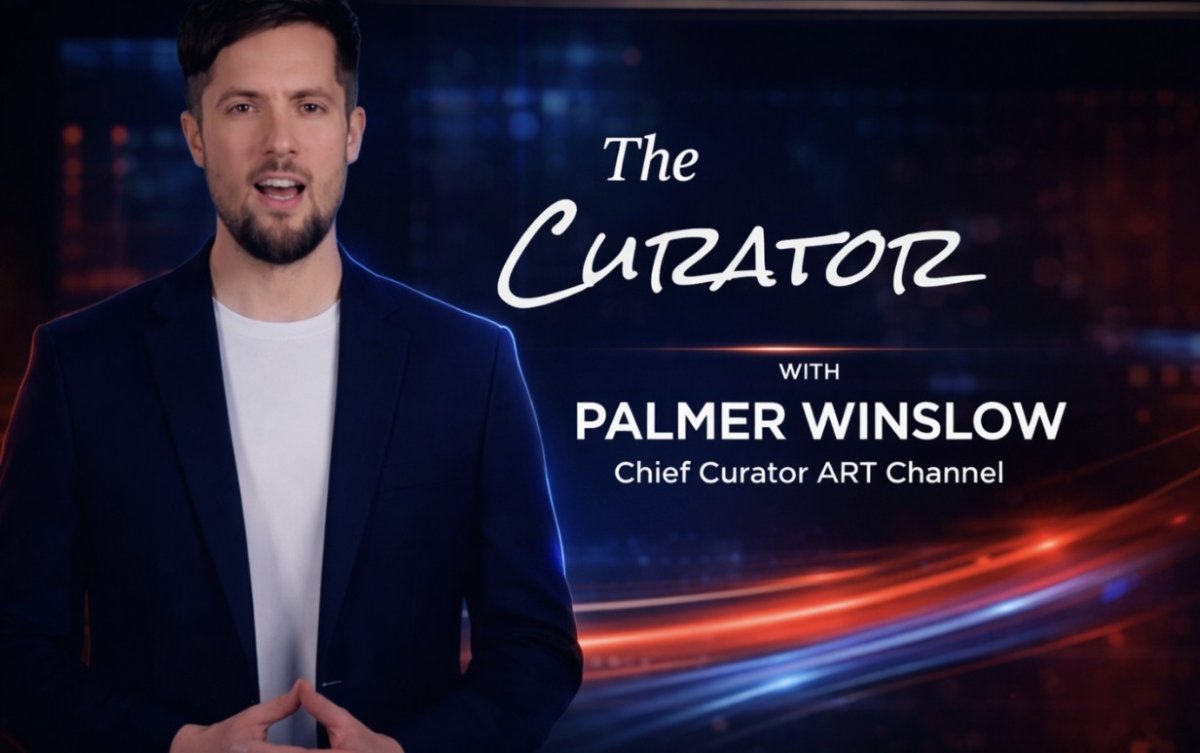
That same philosophy fuels The Curator, the network’s AI-hosted art and culture series fronted by Palmer Winslow and co-chief Annie Jane Cho.

The series explores exhibitions, artistic movements and contemporary creators while blending documentary storytelling with commentary, history and immersive visual design. Episodes often launch alongside real-world gallery openings and museum events across Los Angeles, Hong Kong, Miami and New York.

Leadership believes this intersection between physical cultural experiences and digital media will become increasingly important in the years ahead.

“The line between media and experience is disappearing,” said Kurt A. Swauger. “Audiences don’t just want content anymore. They want connection. They want context. They want something they can emotionally step inside.”

That hybrid approach extends throughout the network’s broader programming slate.

Series like Cooktop Art: Dish’in’ merge culinary creativity with visual art, while other productions examine digital culture, AI-generated creativity, metaverse storytelling and experimental artistic expression.

Photo Courtesy: KAZ

Even The Andy & Jean Show, the platform’s animated series inspired by Andy Warhol and Jean-Michel Basquiat, functions as both entertainment and commentary, exploring celebrity culture, technology and artistic identity through surreal humor and stylized storytelling.

Still, executives acknowledge that originals alone do not sustain a modern streaming business.

Like many FAST services, The ART Channel relies heavily on licensed programming to create rhythm, retention and daily engagement across its ecosystem. Leadership sees that balance between originals and acquired content as essential for long-term growth.

“Original programming gives you identity,” Swauger said. “Licensed programming gives audiences consistency. You need both to create habit.”

The timing may also work in the company’s favor.

As subscription fatigue continues intensifying across the entertainment industry, viewers are increasingly turning toward free ad-supported platforms that remove the friction of recurring monthly costs.

Analysts expect FAST television to remain one of streaming’s fastest-growing sectors over the next several years as audiences continue moving away from expensive subscription stacking.

The ART Channel believes its niche positioning may ultimately become a competitive advantage.

Its audience includes artists, collectors, designers, architects, students, travelers and culturally curious viewers seeking alternatives to formulaic entertainment cycles.

Executives argue that arts audiences have long been underserved by mainstream streaming platforms despite representing a massive global demographic.

“Creativity is universal,” Swauger said. “Art touches every country, every generation and every culture. The audience is much broader than people realize.”

That global outlook is already influencing the company’s next phase of expansion.

Leadership has accelerated subtitled and dubbed programming efforts while building partnerships throughout Europe, Asia and Latin America. International growth, executives say, will become increasingly central to the network’s long-term vision.

Meanwhile, live experiences are becoming a defining part of the platform itself.

Gallery openings, artist interviews, museum walkthroughs, studio visits and international art fair coverage are now being integrated into curated streaming hubs that combine live broadcasts with historical context and companion on-demand content.

The structure mirrors how sports streaming platforms organize live events, but adapted specifically for culture.

“When something important happens in the art world, we want viewers to experience it as it unfolds,” Swauger explained. “Not through social media clips two days later. In the moment.”

That model is also opening new opportunities for sponsors and institutional partnerships.

Rather than relying solely on disruptive commercial advertising, the network increasingly integrates galleries, museums, luxury brands and cultural organizations organically into programming itself.

According to executives, that creates stronger alignment between audiences, advertisers and the storytelling environment.

“Our partners are usually already participating in culture,” Swauger said. “So the integration feels natural rather than intrusive.”

As traditional television continues fading and streaming platforms battle aggressively for attention, The ART Channel is betting that audiences may eventually prioritize quality of experience over quantity of content.

Not louder programming.

Not more franchises.

Just something more thoughtful.

And in today’s entertainment industry, that may be one of the boldest strategies of all.