Market Daily

How WickedFile Enhances Document Management for Auto Repair Shops

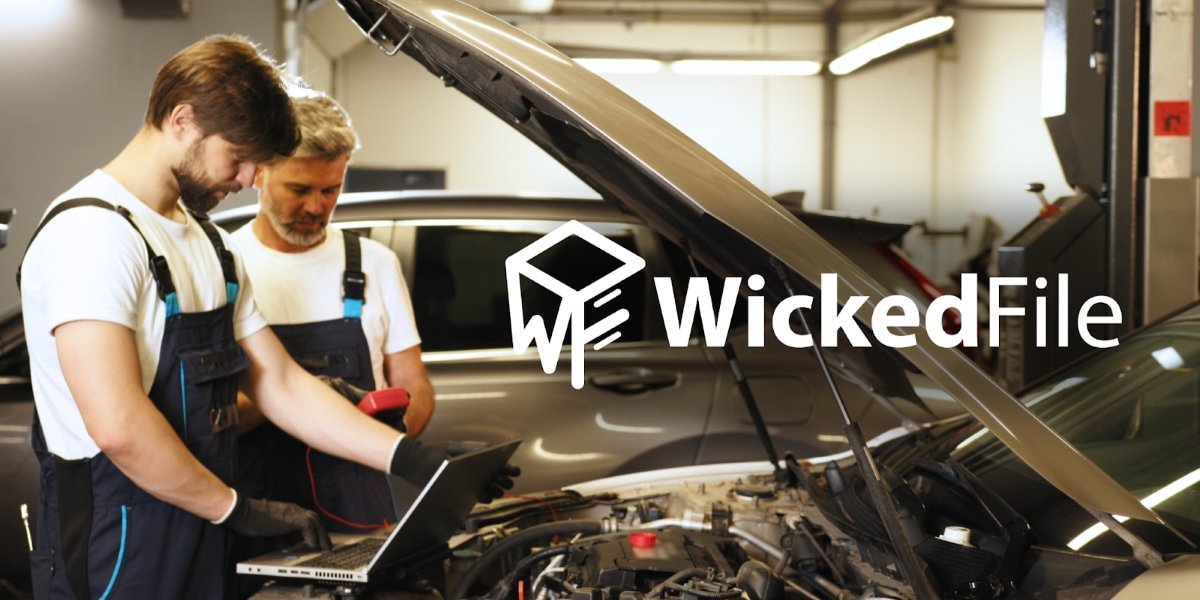
Running an auto repair shop means juggling schedules, customers, repair orders, parts deliveries, and endless paperwork. For many shop owners, keeping records organized and accessible can be a constant challenge. Every invoice, supplier agreement, or compliance document matters—and losing track of even one can cost valuable time and money.

Smarter Document Management, Built for Busy Shops

This new functionality is designed to fit the realities of shop life. In the automotive repair world, time is money. Every minute spent looking for a missing contract or cross-checking invoices is a minute that could have been used to serve customers or close another repair order.

With WickedFile, document management becomes simple and reliable:

Centralized storage: All essential documents—estimates, invoices, supplier agreements, inspection reports, and compliance records—live in one secure hub.

Instant access: Need to review a supplier contract or prove compliance during an audit? With just a few clicks, the document is ready.

Better transparency: Each upload is date-stamped and tied to your shop’s activity, so you know exactly what was filed, when it was filed, and why it matters.

This isn’t just about convenience—it’s about peace of mind. By keeping critical records inside AI tools for automotive business owners, shop owners can meet regulatory requirements with confidence, protect their business from costly oversights, and save valuable time in the process.

Designed for Real-World Shop Needs

The update goes beyond storage—it’s built to handle the details that matter most to auto repair businesses. Whether you’re tracking vendor statements, parts invoices, or return credits, WickedFile ensures that nothing gets lost.

As your shop grows, so does the volume of paperwork. Without the right system, managing these records can quickly spiral out of control. WickedFile scales with your business, giving you a searchable, organized library that grows alongside your operations. This makes audits less stressful, warranty claims easier to process, and vendor disputes faster to resolve.

By acting as an AI analyzer for automotive business owners, WickedFile also connects stored documents with broader financial insights. For example, recurring invoices can be tied back to profit trends, while stored supplier agreements can help identify whether pricing changes are eating into margins. Instead of records sitting idle in a folder, WickedFile transforms them into useful data points that inform smarter decisions.

How WickedFile Enhances Document Management for Auto Repair Shops

Photo Courtesy: WickedFile

Saving Time and Protecting Profits

When questions come up—whether from a customer, a vendor, or an auditor—you’ll have the answers ready. That preparedness not only saves money but also builds credibility for your shop. Vendors trust you because you’re organized, auditors respect your compliance, and customers appreciate the professionalism.

Why This Update Matters

The automotive repair industry is competitive and fast-paced. Rising parts costs, warranty requirements, and compliance regulations make it more important than ever for shop owners to stay on top of their records. The shops that thrive will be the ones that have clear visibility into their operations and finances.

WickedFile’s document upload feature gives shop owners exactly that. It removes the uncertainty of scattered records and replaces it with control, organization, and confidence.

At its core, this update is about more than convenience—it’s about control. By pairing centralized storage with the intelligence of AI tools for automotive business owners, WickedFile allows shop owners to run smarter, stay compliant, and protect profitability.

Instead of wasting time chasing paperwork, you can focus on what matters most: keeping customers on the road and building a stronger, more profitable shop.


Disclaimer: The information provided in this article is for general informational purposes only and should not be construed as professional financial or business advice. The tool described, WickedFile, is presented as a supplementary tool to existing software and business processes. While it aims to help auto repair shop owners identify financial discrepancies, it is not a guarantee of eliminating all financial losses or improving profits. Individual results may vary, and shop owners are encouraged to consult with a financial professional for personalized advice and to ensure that their financial processes meet their specific needs.

Training Support Teams to Address Frustrated Customers

By: Olivia Grant

Training support teams to address frustrated customers isn’t just about scripts or soft skills—it’s about building real confidence under pressure. The primary keyword, “training support teams,” reflects a shift in how companies approach service: not as damage control, but as a strategic function. When frustration hits, the frontline response can either defuse tension or deepen it. That’s why training matters—not just once, but continuously.

Why Frustration Needs a Different Playbook

Frustrated customers don’t behave like neutral ones. They’re impatient, skeptical, and often emotionally charged. Standard service protocols don’t always work in these moments. Training support teams to recognize frustration early—before it escalates—is key.

This starts with tone detection. Whether it’s a sharp email, a clipped chat message, or a raised voice on the phone, reps need to spot the signs. Then comes response calibration. That means slowing down, acknowledging the emotion, and avoiding defensive language. It’s not about solving everything instantly—it’s about showing the customer they’re being heard.

Support teams trained in emotional de-escalation tend to perform better across metrics like first-contact resolution and customer satisfaction. They also experience less burnout, because they’re not absorbing the stress—they’re managing it.

Building Role-Specific Training Modules

Not every support role faces the same kind of frustration. Live chat agents deal with rapid-fire complaints. Phone reps handle longer, more emotional calls. Email teams manage delayed responses and complex issues. Training support teams means tailoring modules to each format.

For chat agents, speed and clarity matter. Training should focus on short, empathetic phrases and fast escalation protocols. For phone reps, tone and pacing are critical. Roleplay exercises help build muscle memory for tough conversations. Email teams need templates that balance professionalism with warmth, plus tools to track unresolved threads.

Cross-training also helps. When reps understand how other channels operate, they can redirect customers more effectively. It also builds empathy within the team—no one’s siloed, and everyone’s equipped to handle pressure.

Using Complaint Data to Shape Training

Customer complaints are a goldmine for training insights. By analyzing common triggers—billing errors, shipping delays, tech glitches—teams can build targeted response strategies. This isn’t just reactive. It’s proactive pattern recognition.

Training support teams with real complaint transcripts helps reps see how frustration unfolds. They learn what phrases escalate tension and which ones calm it. They also see how resolution timing affects tone. A two-hour fix feels different than a two-day wait.

Some companies use heatmaps to track complaint volume by product or service. Others tag complaints by emotional intensity. These tools help trainers prioritize which scenarios to simulate and which scripts to refine.

Coaching, Not Just Training

Initial training sets the foundation, but coaching builds the skill. Support teams need regular feedback—not just on what they said, but how they said it. Tone reviews, call audits, and peer evaluations all help reps grow.

Coaching should be collaborative. Instead of pointing out mistakes, it should highlight what worked and what could be improved. Reps should feel safe experimenting with phrasing, pacing, and empathy techniques.

Some teams use “frustration drills”—short, high-pressure simulations that mimic real customer tension. These drills build confidence and reduce panic during actual interactions. They also help reps internalize the idea that frustration isn’t personal—it’s situational.

Measuring Impact Without Overloading Metrics

Training support teams to address frustrated customers should show up in the numbers—but not all metrics tell the full story. First-response time, resolution rate, and satisfaction scores matter. But so do qualitative indicators like tone shifts and repeat contact reduction.

Surveys can help, especially when they ask about emotional experience. Did the customer feel heard? Did the rep seem calm? These questions reveal whether training is translating into real-world empathy.

Retention is another signal. If frustrated customers stay after a tough interaction, the support team did its job. If they leave, it’s worth reviewing the transcript—not to assign blame, but to refine the approach.

Training support teams isn’t just a cost—it’s an investment. Frustrated customers are often the most vocal. If they’re handled well, they become loyal advocates. If they’re mishandled, they can damage brand reputation fast.

Support teams are the face of the company during its most vulnerable moments. Giving them the tools, language, and confidence to respond with clarity and empathy isn’t optional—it’s foundational.

Using the Hatrix to Categorize Customer Complaints

Customer complaints aren’t just noise—they’re data. And when that data’s structured right, it becomes a roadmap for operational clarity. Using the Hatrix to categorize customer complaints gives businesses a scalable way to decode feedback, spot patterns, and act fast. The Hatrix isn’t a gimmick—it’s a matrix-style framework that helps teams bucket complaints by type, impact, and urgency. It’s already reshaping how service teams triage issues and how execs prioritize fixes.

Why the Hatrix Works for Complaint Categorization

The Hatrix is built on a simple premise: not all complaints are created equal. Some signal systemic breakdowns, others are one-off frustrations. By mapping complaints across two axes—severity and recurrence—teams can visualize which issues need escalation and which ones need refinement.

Severity measures how much damage a complaint causes: financial loss, reputational risk, or legal exposure. Recurrence tracks how often the issue shows up across channels. Together, they form a quadrant system:

  • High severity, high recurrence: critical failures
  • High severity, low recurrence: isolated but urgent
  • Low severity, high recurrence: process inefficiencies
  • Low severity, low recurrence: edge cases

This structure gives service teams a shared language. Instead of vague labels like “important” or “minor,” they can tag complaints with quadrant codes and route them accordingly.

Complaint Typology: From Emotional to Transactional

Using the Hatrix also means classifying complaints by type. Most fall into three buckets:

  • Transactional complaints: billing errors, shipping delays, broken links
  • Emotional complaints: rude staff, tone-deaf messaging, lack of empathy
  • Functional complaints: app crashes, login failures, broken features

Each type requires a different response. Transactional issues need quick fixes. Emotional complaints demand human touch. Functional problems often require engineering support.

This typology isn’t just academic—it’s actionable. For example, if emotional complaints spike after a policy change, it’s a signal that messaging missed the mark. If functional complaints cluster around a new release, QA may need tightening.

Integrating the Hatrix into Service Workflows

To make the Hatrix useful, it has to live inside your tools. That means tagging complaints in CRM systems, embedding quadrant codes in ticketing platforms, and training reps to recognize complaint types on the fly.

Some teams build dashboards that show complaint distribution by quadrant. Others use heatmaps to visualize which product features attract the most frustration. The goal isn’t just to log complaints—it’s to learn from them.

This approach mirrors the logic behind Retail’s Shift Toward Experience-Driven Metrics, which shows how brands are moving beyond raw numbers to interpret customer sentiment.

Benefits of Categorizing Complaints with the Hatrix

The payoff is real. Categorizing complaints with the Hatrix leads to:

  • Faster triage: reps know which tickets to escalate
  • Smarter prioritization: product teams fix what matters most
  • Better reporting: execs see complaint trends at a glance
  • Stronger accountability: teams own their quadrant

It also helps with compliance. When complaints are tagged and tracked, it’s easier to prove responsiveness to regulators or auditors. That’s especially relevant in industries like finance, healthcare, and telecom.

Limitations and How to Mitigate Them

No system’s perfect. The Hatrix relies on accurate tagging, which means training matters. If reps misclassify complaints, the data gets noisy. Also, some complaints span multiple quadrants—like a recurring billing error that also triggers emotional frustration.

To mitigate this, some teams use multi-tag systems or add a “dominant quadrant” field. Others run periodic audits to check tagging accuracy. The key is to treat the Hatrix as a living framework, not a rigid rulebook.

Adlytica Expands Global Reach With AI-Powered Startup Investment and Infrastructure Development

By: Nic Abelian

Adlytica, an innovation-driven technology and venture development company, has recently announced the expansion of its global operations, offering AI-powered infrastructure, investment, and strategic support for startups and enterprises. Founded in 2008 and reestablished in 2022, Adlytica aims to position itself as a trusted partner for businesses navigating digital transformation in the evolving AI landscape.

Results and Milestones

Adlytica has contributed to various business successes worldwide, with notable achievements including:

  • Over 100 technology infrastructures developed to support business growth.
  • More than 50 applications developed across diverse industries.
  • Support for over 20 startups, offering guidance through the incubation process.
  • Assistance in securing over $250,000 in grants through strategic partnerships.
  • Recognition through multiple industry awards for innovation and execution.
  • Established partnerships with AWS, Microsoft, and Cloudflare.

What Sets Adlytica Apart

Unlike conventional accelerators or consultants, Adlytica combines technical auditing with hands-on execution. The company specializes in designing secure, self-hosted large language models (LLMs) and AI-driven infrastructure that are tailored to meet the unique needs of businesses.

“Our philosophy is simple: we don’t just advise, we collaborate with founders,” said Shubham Kishore, Founder and CEO of Adlytica. “From auditing infrastructure to deploying AI-powered systems, we work to help startups and enterprises build scalable businesses and remain competitive in a dynamic market.”

Client Testimonials

Real clients highlight the company’s value:

“Adlytica supported us in automating services and outreach, while also elevating our brand with expert PR.” – Mikhail

“Their partnership allowed us to become Lotto.pl’s official partner and develop the LottoSkan app.” – Marc Krol

“Adlytica assisted us in building a secure, self-hosted LLM trained on our company data. It significantly improved our customer support and internal processes.” – Joanna

Who Adlytica Helps

Adlytica supports:

  • Founders & Early Startups – Assisting with MVP development, funding opportunities, and scaling operations.
  • Midcap Companies – Developing AI-driven infrastructure to optimize costs and performance.
  • Accelerated Startups & CEOs – Expanding reach through investor connections, PR, and AI product development.

Common Questions Answered

What is Adlytica?

Adlytica is a global AI-powered venture development and infrastructure company that works with startups and enterprises to build secure AI systems, offer investments, and provide long-term support.

Is Adlytica a credible company?

Yes. With 100+ successful technology deployments, over 20 startup investments, global partnerships with AWS, Microsoft, and Cloudflare, and recognition from multiple industry awards, Adlytica is a respected and credible organization.

Who runs Adlytica?

The company is led by Shubham Kishore, Founder & CEO, who has significant experience in AI, venture building, and digital transformation.

What does Adlytica specialize in?

Adlytica specializes in startup incubation, AI infrastructure development, and the deployment of secure LLM/SLM solutions tailored for businesses seeking scalable, high-performance solutions.

Expanding the Future of AI Innovation

Adlytica’s commitment to reshaping the future of AI and venture development continues to grow. By blending cutting-edge technology with deep industry expertise, Adlytica aims to position itself as a key player in AI-powered digital transformation. With a track record of delivering secure AI infrastructure and developing self-hosted LLMs, the company remains focused on helping businesses scale effectively in today’s rapidly evolving market.

As it extends its global footprint, Adlytica continues to provide the essential tools and strategic guidance that enable businesses to grow with confidence. Its forward-thinking approach focuses on enhancing operational efficiencies while exploring new AI applications that will promote long-term, sustainable growth across various industries.

About Adlytica

Adlytica (founded in 2008, reestablished in 2022) is an AI-powered investment and infrastructure development firm based in Poland and the USA. The company invests in early and mid-stage startups while delivering custom AI infrastructure, self-hosted LLMs, and digital transformation services. With 100+ infrastructure deployments, 20+ startup investments, and global tech partnerships, Adlytica is committed to driving AI innovation for founders and businesses worldwide.

Media Contact

Shubham Kishore
CEO, Adlytica
Email: s.k@adlytica.com
Website: AI business infrastructure solutions | startup investment and incubation | secure AI model development


Disclaimer: The information in this article is provided for general informational purposes only and does not constitute investment advice. Any statements regarding potential outcomes or success should not be interpreted as guarantees. Individual results may vary. Adlytica does not guarantee funding, business success, or any specific outcomes for participants in their incubator program. Readers should consult with financial, legal, or business professionals before making any decisions based on the content provided. The company does not endorse or recommend any specific business practices, investments, or strategies.