
Credit Card Processing Loans for Retail and Restaurants


Credit card processing loans pay you up front and collect through a share of your future card sales. For a boutique with weekend rushes or a restaurant with a busy patio, repayment that moves with sales can be genuinely useful. It can also be expensive and confusing. Because no list of names can tell you whether a specific company will treat you fairly, this guide teaches you how to spot the difference yourself: green flags, red flags, and what each one means for retail and restaurant owners.
The example numbers are illustrative, and the businesses are fictional. Market pricing varies.
How These Products Work
Most are built around a simple exchange. You receive a lump sum and agree to deliver a larger fixed amount, collected as a percentage of each day’s card settlements, known as the holdback. Some are structured as advances and others as loans with a processor split. To see one company’s description of this structure, take a look at Fundivi retail and restaurant card loans, then compare it to the actual language of any contract you receive.
Three numbers drive nearly everything:
- Factor or payback multiple: the total you’ll deliver for each dollar advanced
- Holdback percentage: the slice taken from card sales
- Your card volume: which sets how long collection lasts
Green Flags and Red Flags at the Offer Stage
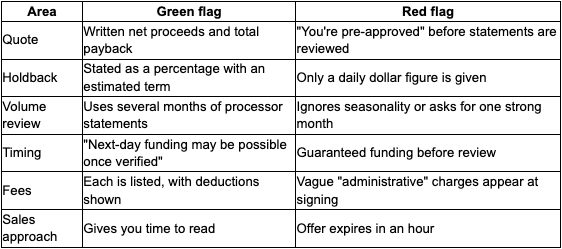
If an offer shows two or more red flags at this point, stop and ask for clarification in writing before you share more financial data. Be careful, too, about who’s asking. This Fundivi press release on business loan fraud prevention, posted on Business Insider’s markets site, touches on business loan fraud as well as lender ratings, and both topics belong in your early screening.
Green Flags and Red Flags in the Contract
Identifying the Good Deal in a Restaurant
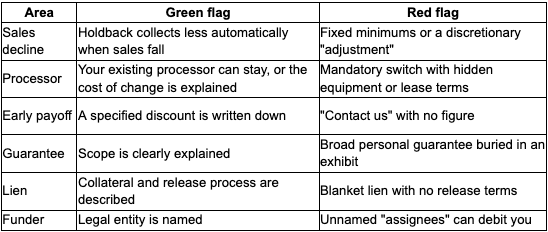
Restaurants have thin margins, high card share, and sharp seasonal swings. Tips can also inflate settlements, which matters because a holdback calculated on gross card receipts may include money that’s already owed to staff.
Juniper Street Grill, a fictional bistro with $85,000 in monthly card sales, considers this offer for a kitchen renovation.
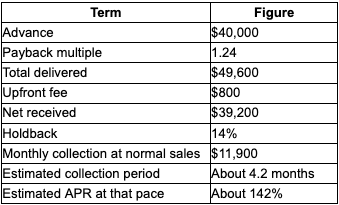
During a winter slump, card sales fall 25% to $63,750. The holdback now collects $8,925 monthly, so the term stretches to about 5.6 months. The total remains $49,600, and the true holdback is doing what it should.
Restaurant green flags: The funder asks about your slow months, understands tip treatment, and doesn’t push a processor change during service season.
Another restaurant green flag: The contract states whether delivery-app payouts count as receipts, since those can settle through a separate channel and some owners rely on them heavily.
Restaurant red flags: Fixed daily debits on a business whose Tuesdays look nothing like its Saturdays, or a term estimate based only on a busy holiday month.
A useful test is whether the $10,400 total cost can be recovered from the new kitchen’s added profit within a reasonable time. If the renovation can’t achieve that, a cheaper or smaller option should be considered first.
Identifying the Good Deal in Retail
Retail cash flow often moves in waves, with heavy purchasing months before heavy selling months. Stores also accept more returns, and chargebacks and refunds can affect net settlement.
Fern & Thread, a fictional apparel shop with $45,000 in monthly card sales, gets a $25,000 offer at a 1.30 multiple with a 12% holdback. It would deliver $32,500 for a cost of $7,500. At normal volume, collection is $5,400 monthly, or about 6 months.
Retail green flags: The term estimate accounts for the seasonal curve, refunds are addressed, and the funder asks when the inventory will sell.
Red flags specific to retail: A term estimate based on December volume when you’re borrowing in August, or no mention of what occurs if you change registers or add a second location.
The timing issue is the big one. Fern & Thread buys its fall stock in August, and sales arrive in October. If collection starts at the next day’s settlements, the shop pays before the merchandise earns anything, so the owner needs to be confident that summer sales can carry the holdback for two months.
That same owner might also ask whether a lender explains all this without being pushed. This overview of transparent small business lenders uses transparency as its theme, which is a good frame for your own comparison, so apply the columns above to any company you consider.
Verifying Who You’re Talking To
Card merchants are frequent targets for unsolicited offers, particularly since processor data and business listings are easy to find. Treat verification as a test of the company, too. A legitimate provider won’t object when you hang up and call back through a number from its own website or a state business registry. Use a phone number you’ve found on your own, and never pay a fee up front to release funds.
Separating Reputation From Marketing
Green flags: Recent specific reviews, a published explanation of how an evaluation works, and a company that’s easy to identify.
Red flags: Only perfect reviews, no named legal entity, or a rating site that doesn’t explain its method.
As one data point, Business Loans IQ names Fundivi its Editor’s Pick and scores it 4.8 out of 5 on BusinessLoansIQ.com card funding ratings. Check how that site is compensated and what its score measures before relying on it. A rating cannot tell you what your holdback or payback would be.
Questions That Bring Flags to the Surface
Sometimes a flag won’t show until you ask. Try these with any provider:
- What does your holdback become if your card volume doubles or halves?
- If you add a second terminal or a new online store, do those sales count?
- How will refunds and chargebacks reduce the amount collected?
- Is the full agreement available to review before a credit check is authorized?
A direct, specific reply is a green flag of its own. A promise to explain it all later is not.
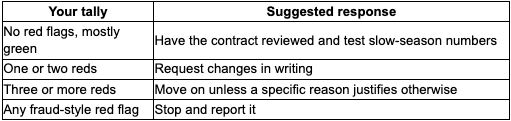
A Five-Minute Flag Count
Take any offer and tally both contract and offer tables.
Frequently Asked Questions
Is a card processing loan the same as a merchant cash advance?
They overlap. Some are advances, and some are loans with a split, and that distinction can affect your rights and costs.
What holdback percentage is normal?
Figures often fall somewhere around 10% to 20%, but what matters is what your margins can handle.
Does a restaurant have to switch processors?
It depends on the offer. Ask, and check for equipment leases or termination charges.
What if card sales fall sharply?
With a true percentage holdback, collections typically fall too, while the total stays the same.
Are cash sales included?
Usually only card settlements count, but read the definition of receipts because some contracts reach further.
How fast could you receive funds?
It may be possible within a few days or sooner for qualified applicants after processor records are verified.
Disclaimer: This article is for informational and educational purposes only and does not constitute financial, legal, or professional advice. Financing options, eligibility requirements, costs, and repayment terms may vary depending on individual circumstances and providers. Any examples presented are illustrative and do not guarantee specific outcomes. Readers are encouraged to conduct independent research and consult a qualified financial professional before making financial decisions.