Market Daily

Why Magnetic Skyrmions Matter for Neuromorphic Computing as AI Energy Demand Grows


Neuromorphic computing, which aims to process information more like the human brain, is drawing new attention as AI’s energy needs climb. Magnetic skyrmions are one candidate building block for that approach. A 2025 study from Johannes Gutenberg University Mainz, now back in circulation, shows the kind of precise control researchers need before skyrmion-based devices become practical.

Key Takeaways

  • A study published in Nature Nanotechnology in 2025 filmed a two-dimensional skyrmion lattice melting in real time while researchers controlled individual skyrmions.
  • The research was led by Johannes Gutenberg University Mainz, with contributions from the Norwegian University of Science and Technology (NTNU), which recirculated the findings on October 26, 2026.
  • The lattice melted in two distinct steps, unlike three-dimensional solids such as ice.
  • Skyrmions are studied as possible building blocks for future data storage and brain-like computing.
  • The International Atomic Energy Agency expects nuclear power use could more than triple by 2060, citing AI data centers among the drivers.

Neuromorphic Computing Aims to Work More Like the Brain

Conventional computers keep memory and processing in separate places. Data constantly moves back and forth between them, and that movement costs time and energy. Neuromorphic computing takes a different approach, modeled on how the brain’s neurons and synapses work. Memory and processing sit in the same place, and many operations happen in parallel.

The goal is computing that handles certain tasks, such as pattern recognition, with far less energy than today’s chips. Building that kind of hardware requires new physical components that can store and process information in different ways. Skyrmions are one of the options researchers are studying.

What Skyrmions Are and Why Researchers Study Them

Skyrmions are tiny magnetic vortices that form in thin magnetic materials, often described as microscopic magnetic whirlpools. They are stable, they can be moved with small amounts of energy, and they can be created and erased. Those properties make them interesting for spintronics, a field of electronics that uses the spin of electrons, not just their electric charge, to carry information.

Magnetic skyrmions can exist on their own, but when packed densely enough, they arrange themselves into an ordered lattice, much like atoms in a crystal. Understanding how that lattice forms and breaks down matters for any future device that would rely on skyrmions behaving predictably.

The Mainz Study Filmed a Skyrmion Lattice Melting in Real Time

The research behind this round of neuromorphic computing news was conducted mainly at the Institute of Physics at Johannes Gutenberg University Mainz, in Professor Mathias Kläui’s group, with lead author Raphael Gruber. Asle Sudbø, who heads NTNU’s Centre for Quantum Spintronics, contributed to the study. It was published in Nature Nanotechnology in 2025. NTNU’s October 2026 release has brought it back into wider circulation.

The team created skyrmions by carefully tuning temperature and magnetic fields, then watched them through a magneto-optical Kerr microscope, an instrument that images magnetic patterns using light. By adjusting magnetic fields, the researchers changed the size and mobility of individual skyrmions while filming. “For the first time, researchers have managed to film how a magnetic skyrmion lattice melts in real time,” Sudbø said in NTNU’s release.

The results showed that the two-dimensional lattice melts in two steps. First, the skyrmions lose their regular spacing while still holding a lattice pattern. Then the lattice’s orientation breaks down, and the structure dissolves completely. Shrinking the skyrmions made them more mobile, which pushed the lattice toward disorder. That is the kind of control over individual magnetic structures researchers will need if skyrmions are ever used to store or process data.

Energy Efficient Computing Is Becoming a Business Issue

The renewed interest in research like this reflects a practical problem: AI is expensive to power. In its annual report to the United Nations General Assembly, delivered October 23, the International Atomic Energy Agency said it expects nuclear power use could more than triple by 2060. The agency cited electrification, AI-powered data centers and technology companies’ demand for reliable, carbon-free power as drivers.

AI hardware spending is already showing up in economic data, including record capital goods imports tied to the AI infrastructure buildout. Every new data center needs power, and electricity costs flow through to cloud pricing and, eventually, to the businesses that rely on AI tools. Energy efficient computing has moved from a research goal to a cost concern for companies of every size.

Skyrmion-Based Computing Remains Early-Stage Research

The Mainz study is basic research. It explains how skyrmion lattices behave and how they can be controlled, but it does not describe a working device, a product or a timeline. Moving from controlled laboratory observations to reliable, manufacturable components is a long process, and many promising materials never make that leap.

The takeaway is directional rather than immediate. Research into fundamentally more efficient computing is active and well funded, and it is gaining relevance as AI’s energy demands grow. Skyrmions are one path among several, and studies like this one are the groundwork any eventual technology would depend on.

FAQs

What Is Neuromorphic Computing?

Neuromorphic computing is an approach to computer design modeled on the brain, where memory and processing happen in the same place and many operations run in parallel. The aim is to perform tasks such as pattern recognition using far less energy than conventional chips.

How Does Neuromorphic Computing Work?

Neuromorphic hardware uses components that mimic how neurons and synapses work, storing information where it is processed instead of moving data between separate memory and processing units. Researchers are testing several physical systems for this, including magnetic structures such as skyrmions.

What Is Spintronics?

Spintronics is a field of electronics that uses the spin of electrons, a magnetic property, in addition to their electric charge to store and process information. Magnetic skyrmions are studied within spintronics as possible building blocks for future memory and computing devices.

How Does AI Affect Energy Consumption?

AI runs in data centers that need large, constant supplies of electricity, which raises overall power demand. The International Atomic Energy Agency cites AI data centers among the drivers of its expectation that nuclear power use could more than triple by 2060.


Talking Tree Brings a More Accessible Approach to Artificial Intelligence in the Legal Sector

Artificial intelligence is creating new possibilities for the legal industry, helping professionals streamline document preparation, review contracts, and manage repetitive tasks. However, access to these capabilities remains uneven. While major legal technology companies primarily serve established firms and corporate departments, individuals and smaller businesses often face financial barriers when seeking comparable digital assistance.

Talking Tree, a California-based nonprofit established in 2024, is working to address this gap. Its approach combines AI-powered legal tools with a nonprofit operating model intended to keep services affordable for people and organizations that may not have the resources to invest in expensive enterprise software.

The organization focuses on practical legal tasks, including document drafting, contract analysis, and explanations of complex legal language. By prioritizing accessibility over profit maximization, it aims to make technology-assisted legal support available to a broader audience.

Expanding Access to Everyday Legal Tools

Legal paperwork can create considerable challenges for people who lack dedicated legal teams. Entrepreneurs setting up a company, small-business owners reviewing commercial agreements, and individuals trying to understand contractual obligations may need help navigating unfamiliar terminology and requirements.

Traditional legal services remain important, particularly when a matter requires professional judgment. Nevertheless, routine preparation and document review can consume time and money that smaller organizations cannot easily spare.

Talking Tree aims to make some of these tasks more manageable through its AI-powered platform. Its pricing approach is designed to cost substantially less than many comparable market offerings. The organization has also described usage-based pricing starting at around $20 per user each month.

This model is intended to reduce the financial commitment required to access legal technology. Rather than paying for a large package of enterprise seats, smaller teams can use tools suited to their actual needs.

A Different Position in a Competitive Industry

The legal AI market includes well-funded companies such as Harvey and Legora, which provide technology for professional legal teams and larger organizations. Their platforms invest heavily in workflow automation, software integrations, and systems designed to support complex legal operations.

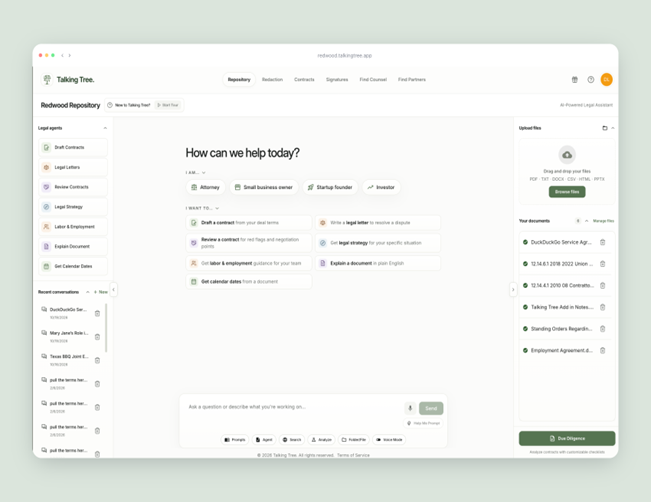
Talking Tree follows a more focused strategy. Its legal AI companion, Redwood, offers capabilities such as voice interaction, contract drafting and review, document redaction, and access to a library of templates. The organization also helps users find vetted lawyers when a situation requires additional professional expertise.

Rather than attempting to reproduce every enterprise feature, Talking Tree concentrates on common legal workflows that can benefit from structured AI assistance.

The underlying AI models used by legal technology providers are an important part of this landscape. Talking Tree, Harvey, and Legora have built their products using models from major AI developers, including OpenAI, Anthropic, and Google. The differences between their offerings therefore extend beyond the models themselves to product design, workflow support, integrations, and safeguards.

For Talking Tree, concentrating on a narrower set of tasks allows its small team to focus its development efforts on the needs of individuals and smaller organizations.

Leadership Informed by Practical Legal Experience

Photo Courtesy: Talking Tree (Talking Tree’s LLM driven chat assistant tool)

Talking Tree’s founding team brings together experience in legal practice, software engineering, and technology infrastructure.

Cecilia Wang has worked across private practice and corporate legal departments. Her legal background includes antitrust work at Morgan Lewis, intellectual property litigation at Quinn Emanuel, and a federal clerkship with the U.S. District Court in Tennessee. She later held corporate legal roles in the semiconductor industry and at Meta before moving into a senior legal leadership position at a smaller public company.

That experience exposed her to the operational pressures faced by lean legal teams, including limited staffing, fragmented information, and heavy workloads. Wang developed AI workflows to improve efficiency and reported that these efforts reduced legal spending by nearly half. Her experience helped inform Talking Tree’s focus on practical, cost-conscious legal tools.

Michael Greenwald, the founding engineer, is responsible for building Talking Tree’s core: the AI pipeline, backend business logic, and user interface. He’s a full-stack engineer who studied linguistics and computer science at UCLA, then spent a decade building across web, mobile, and emerging interfaces. At the LA agency ISBX, he built back-end systems and admin tools for startups and enterprises. He learned Unity in his spare time because he enjoyed making games, and that hobby led to a role at Stayhealthy, where he helped develop the augmented-reality health app Color Quest, which surpassed three million downloads. He also helped reduce the app’s size by three-quarters to keep it fast.

Alex Lu, who oversees technology and infrastructure, has built her career across art and technology, working in technical roles at Microsoft and Intuit and doing visual design work at NASA’s Jet Propulsion Laboratory. Her earlier modeling career under the name Alix Lu (Instagram: @_alixlu) also gave her opportunities to work with startups in a different capacity. She produced investor-facing product videos and appeared as the public face of a makeup virtual-try-on startup, and was later featured in Harper’s Bazaar Vietnam.

All three founders graduated from UCLA. According to the supplied organizational profile, they do not draw salaries from Talking Tree, reflecting the team’s commitment to its nonprofit mission. At the same time, its limited staffing means the organization must prioritize its resources carefully as the product develops.

How the Nonprofit Model Shapes Its Services

Talking Tree’s nonprofit structure is central to its approach. The organization operates as a 501(c)(3) nonprofit based in Sunnyvale, California, and reinvests revenue into its services rather than pursuing conventional shareholder returns.

Its latest public financial figures cited in the supplied profile indicate approximately $427,000 in revenue and $407,000 in expenses. Donations and grants help support its work, while the organization seeks to maintain an operating model focused on affordability.

This structure makes it possible to serve users whose budgets may not justify enterprise legal software. For these customers, the alternatives might otherwise be a generic chatbot, a free online template, or attempting to navigate legal documents without specialized digital assistance.

However, affordability is only one consideration when evaluating legal AI. Generated content can contain errors, and a document that appears straightforward may involve jurisdiction-specific rules or significant legal consequences. Users should therefore verify important outputs and seek qualified legal advice when necessary.

The organization acknowledges the importance of professional assistance by directing users toward vetted lawyers when appropriate. This connection between accessible technology and human expertise is particularly relevant for users who do not have an in-house legal department.

A smaller operating structure also presents practical challenges. Maintaining reliable systems, strengthening safeguards, and expanding product capabilities requires ongoing resources. Meanwhile, commercial platforms continue to evolve, and general-purpose AI assistants are becoming increasingly capable of handling basic drafting tasks.

Talking Tree will need to balance its affordability goals with the investment required to maintain a dependable service.

Building a Practical Alternative for Underserved Users

Talking Tree’s opportunity lies in serving people who may not otherwise purchase dedicated legal software. Individuals, entrepreneurs, and smaller businesses often need help with routine paperwork but cannot justify the costs associated with larger professional platforms.

The organization’s product strategy is built around this audience. By offering focused drafting and review tools, plain-language explanations, templates, and pathways to professional legal support, it seeks to make common legal workflows easier to navigate.

Talking Tree also provides educational resources through its free newsletter, which includes legal information, do-it-yourself guides, and explanations intended for a general audience.

Its long-term success will depend on whether it can maintain an affordable service while improving its capabilities and managing the risks associated with AI-generated legal information. Competition from both enterprise providers and general-purpose AI tools will continue to shape the market.

Rather than competing directly with the largest legal technology companies on scale, Talking Tree is pursuing a different objective: making useful legal technology available to people who have historically been priced out of the market.

For individuals and smaller organizations seeking help with everyday legal tasks, that focus could offer a practical entry point into AI-assisted legal work. The organization’s challenge is to ensure that accessibility remains matched by appropriate safeguards, reliable tools, and clear guidance on when professional legal advice is needed.

Learn more about its services at Talking Tree.