
Market Daily

Children’s Book Writing Services for Non-Fiction: How City Light Publishers Helps Authors Educate Young Readers Through Engaging Stories

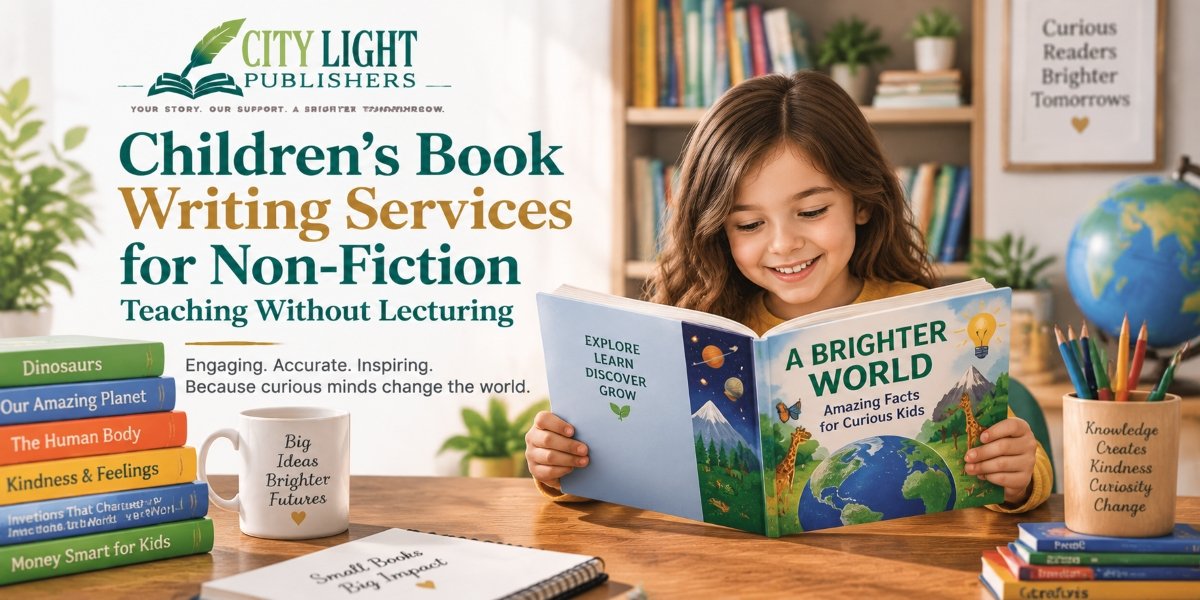
Writing a children’s nonfiction book requires more than collecting facts and presenting information. The real challenge is transforming complex subjects into engaging experiences that encourage curiosity while maintaining accuracy.

Unlike many adult nonfiction books, children’s nonfiction must satisfy two different expectations. It must provide reliable information while also capturing the attention of young readers who may not have intentionally chosen to learn about the topic. A successful children’s nonfiction book does not feel like a textbook. Instead, it invites exploration, discovery, and imagination.

Children’s book writing services help authors transform educational ideas into structured, age-appropriate books that connect with young audiences. City Light Publishers provides children’s book writing and children’s book editing services, recognizing that nonfiction for young readers requires specialized attention to accuracy, structure, storytelling, and presentation.

Understanding the Different Types of Children’s Nonfiction Books

Children’s nonfiction can take many different forms, and each format requires a unique writing approach.

Concept books introduce young children to basic ideas such as colors, numbers, shapes, and opposites. Although these books may appear simple, creating them requires careful planning because repetition, rhythm, and sequencing must work together to support early learning.

Narrative nonfiction presents real information through storytelling. These books may explore an important discovery, an animal’s life cycle, a historical event, or the journey behind an invention. By using storytelling techniques, narrative nonfiction allows children to connect emotionally with factual information.

Expository nonfiction focuses on explaining a subject, such as how the human body works, why volcanoes erupt, or how technology functions. The challenge is creating a structure that informs without becoming a collection of disconnected facts.

Social-emotional nonfiction explores feelings, relationships, and personal experiences. These books can help children understand emotions, friendship, change, and challenges, but they must be handled carefully to avoid becoming overly instructional.

Biography introduces children to real people and their achievements. The challenge is making a person’s life understandable and meaningful for young readers who may not have knowledge of the historical or cultural background surrounding that individual.

Professional children’s book writing services help authors determine which structure best fits their idea and audience.

Starting With a Child’s Question Instead of an Adult’s Subject

The strongest children’s nonfiction books begin with curiosity.

Adults often organize information based on the structure of a subject. They may begin with history, explanations, definitions, and examples. Children approach learning differently. They naturally ask questions such as “Why does this happen?”, “How does it work?”, “What would happen if?”, or “How big is it?”

A successful children’s nonfiction book is often built around the question a child would genuinely ask.

For example, “The ocean” is a broad topic, but “What lives in the deepest part of the ocean?” creates a focused idea that immediately sparks curiosity.

Choosing a specific angle helps create a stronger reading experience because children are drawn toward discovery rather than simply receiving information.

Balancing Accuracy With a Child’s Reading Level

One of the most difficult parts of writing nonfiction for children is simplifying information without making it inaccurate.

Young readers need explanations that are easy to understand, but those explanations must also remain truthful. Removing unnecessary complexity is important, but changing facts into misleading statements can create confusion later.

Professional children’s book writers must carefully decide which details are essential and which can be introduced at a later stage. The goal is not to reduce knowledge but to present it in a way that matches the child’s understanding.

Accuracy also requires careful handling of uncertainty. When science or history includes information that continues to develop, writers must avoid presenting guesses as absolute facts. The information children remember should always be the correct information.

City Light Publishers highlights the value of subject expertise during the editing process, as editors familiar with specific fields can help identify whether a simplification improves understanding or creates distortion.

Creating Emotional Books Without Turning Them Into Lessons

Social-emotional children’s books are among the most requested categories, but they are also among the easiest to make ineffective.

A common mistake is creating a story where a child faces a problem, an adult explains the lesson, and the final page directly states the message. While the intention may be positive, children often recognize when a story is teaching them instead of allowing them to experience the story naturally.

The strongest emotional books show rather than explain.

A story about a child feeling nervous on the first day of school becomes meaningful when it shows the real experience; the uncomfortable feelings, the small mistakes, the uncertainty, and the moment of growth.

A useful test is removing the final explanation. If the story still communicates its meaning, the message was naturally built into the experience. If the story loses its impact, the explanation may have replaced the storytelling.

Effective children’s book writing services focus on creating authentic experiences rather than simply delivering lessons.

Why Back Matter Adds Value to Children’s Nonfiction Books

Children’s nonfiction has an advantage that many fiction books do not: additional educational content at the end of the book.

Glossaries, timelines, source notes, activity sections, and further reading recommendations can make a children’s nonfiction book more valuable for families, teachers, and libraries.

These additional sections help expand the usefulness of a book because the same title can support different age groups. Younger children may enjoy the main story through reading aloud, while older children can explore the additional information independently.

For adult buyers, including research notes and supporting information also demonstrates credibility and helps establish trust in the quality of the book.

Understanding the Children’s Nonfiction Market

Children’s nonfiction publishing works differently from many other categories because purchases are often influenced by parents, educators, libraries, and gift buyers.

This makes professional presentation especially important. Physical books remain highly valuable in this category because schools, libraries, and families often prefer printed copies.

Book covers also serve an important purpose because adult buyers frequently make quick decisions based on whether the book appears trustworthy, age-appropriate, and professionally produced.

Series potential can also create long-term value. A successful format that introduces children to multiple subjects can become a collection rather than a single book.

City Light Publishers states that authors retain 100% ownership, rights, and royalties, making ownership an important consideration for authors developing characters, formats, or educational series with future potential.

Professional Production for Children’s Nonfiction Books

Children’s nonfiction books require careful production because they often depend heavily on illustrations, layouts, and visual organization.

Professional formatting must consider image quality, margins, print requirements, and the differences between digital formats. Fixed-layout digital editions and printed books with illustrations require specific production standards to maintain quality.

City Light Publishers supports authors through editing, formatting, cover design, printing, and distribution across platforms including Amazon KDP, Barnes & Noble, Kobo, Apple Books, Google Books, IngramSpark, and Draft2Digital.

However, production quality alone cannot replace strong writing. A beautifully designed book still needs a meaningful question, accurate information, and engaging storytelling to keep young readers interested.

Helping Authors Create Meaningful Educational Stories

A successful children’s nonfiction book does not simply provide information. It creates curiosity, encourages exploration, and helps young readers understand the world around them.

City Light Publishers provides children’s book writing services designed to help authors transform educational ideas into engaging nonfiction books for young readers.

Through professional writing, editing, formatting, design, and publishing support, authors can create children’s books that educate without lecturing and inspire children to continue learning beyond the final page.

Why Sue Phillips Continues to Define Luxury in Fragrance

Luxury has always been defined by what cannot be replicated. It is found in exceptional craftsmanship, timeless design, personalized experiences, and the emotional connections people create with the world’s finest brands. Few individuals understand this philosophy more intimately than Sue Phillips, an internationally recognized fragrance expert, author, entrepreneur, and founder of Scenterprises.

For more than four decades, Phillips has quietly shaped the fragrance industry from behind the scenes while building a remarkable legacy of innovation. From creating iconic fragrance launches for global luxury brands to developing personalized scent experiences for clients from around the world, she has transformed perfume from a simple beauty product into one of the most intimate forms of personal expression.

Today, as founder of the Scenterprises Fragrance Studio in New York City, Phillips continues to redefine what luxury means by proving that the most memorable accessory a person can wear is one that cannot be seen. It can only be experienced.

A Career Built on Innovation

Before becoming a widely respected voice in the fragrance world, Sue Phillips developed an extraordinary foundation inside some of the industry’s most prestigious companies.

Her career includes executive leadership positions with globally recognized luxury houses, including Tiffany & Co., where she served as Vice President of Marketing for Fragrance. During her tenure, Phillips played a key role in helping establish fragrance as an essential extension of luxury branding.

She later contributed to successful fragrance launches and brand development for renowned names including Burberry, Trish McEvoy, Avon, Diane von Furstenberg, Lancaster, and many other internationally recognized beauty and fashion companies.

While countless consumers recognize these iconic fragrances, few realize the strategic vision and creative expertise required to transform a brand’s identity into an unforgettable scent.

For Phillips, fragrance has never been simply about perfume.

It is storytelling.

It is psychology.

It is branding.

It is memory.

Most importantly, it is emotion.

The Invisible Luxury

Unlike fashion, jewelry, or handbags, fragrance exists in a completely different category of luxury.

It cannot be photographed.

It cannot be displayed on social media.

Its greatest impact happens in memory.

That understanding has guided Phillips throughout her career.

She believes fragrance communicates personality before words are ever spoken. Scientific studies have repeatedly demonstrated that scent is closely connected to emotion and long-term memory, making fragrance one of the most powerful sensory experiences humans possess.

This philosophy became the inspiration behind her signature approach to fragrance customization.

Rather than asking clients what perfume they currently wear, Phillips begins with a very different question:

“How do you want people to remember you?”

That simple conversation often becomes the beginning of an entirely personalized fragrance journey.

Creating the World’s Most Personal Luxury

Walk into the Scenterprises Fragrance Studio in New York and you’ll quickly realize this isn’t a traditional perfume boutique.

Instead of browsing shelves filled with designer fragrances, guests participate in an immersive consultation designed to uncover personality, lifestyle, preferences, memories, and emotional connections.

Every consultation is highly individualized.

Every fragrance becomes completely unique.

No two creations are identical.

Clients participate in selecting notes ranging from delicate florals and bright citrus to sophisticated woods, warm ambers, exotic spices, and rich musks. Throughout the creative process, Phillips guides each guest through the art and science of fragrance composition until the final scent reflects their personal identity.

The result is something increasingly rare in today’s luxury marketplace:

A product created exclusively for one individual.

No mass production.

No trend following.

Simply authentic personalization.

Luxury Is Becoming Personal Again

As luxury consumers increasingly seek experiences rather than possessions, Phillips’ philosophy has become more relevant than ever.

Today’s discerning clientele wants authenticity.

They value craftsmanship.

They seek meaningful experiences over status symbols.

Personalized fragrance represents all three.

Rather than purchasing another recognizable perfume worn by millions of people worldwide, clients leave with something that belongs only to them.

This shift reflects a broader evolution occurring throughout the luxury marketplace.

Customization is replacing standardization.

Experiences are becoming more valuable than products.

Storytelling has become the new currency of premium brands.

Sue Phillips recognized this movement years before personalization became an industry trend.

The Science Behind Emotion

Phillips often describes fragrance as “the invisible accessory,” but its influence extends well beyond fashion.

Research has shown that scent is processed through areas of the brain associated with memory and emotion, making fragrance uniquely capable of triggering vivid recollections and emotional responses.

A familiar aroma can instantly transport someone back to childhood.

It can recall a wedding day.

A favorite vacation.

A loved one.

A milestone achievement.

This remarkable relationship between scent and memory inspired Phillips to write her book, The Power of Perfume.

The book explores how fragrance influences confidence, relationships, emotional well-being, branding, and personal identity while making the science of scent accessible to everyday readers.

It has become an essential guide for anyone interested in understanding why fragrance affects human behavior so profoundly.

Building Confidence Through Fragrance

Throughout her career, Phillips has witnessed thousands of transformations that have little to do with appearance.

Instead, they begin with confidence.

She believes the right fragrance can become part of an individual’s personal presence, helping reinforce how they wish to be perceived professionally and socially.

Executives often seek fragrances that project authority and sophistication.

Entrepreneurs look for scents that communicate creativity and originality.

Brides desire fragrances that preserve one of life’s most meaningful memories.

Families commission custom scents to celebrate anniversaries, birthdays, and multi-generational milestones.

Each project reflects Phillips’ belief that fragrance becomes part of a person’s story.

A Global Authority

Phillips’ expertise has made her a sought-after voice in fragrance media.

She has appeared on major television programs, radio broadcasts, podcasts, and digital platforms discussing fragrance trends, luxury branding, wellness, gift-giving, and seasonal scent recommendations.

Her approachable style makes complex fragrance concepts understandable while inspiring audiences to think differently about scent.

Whether speaking with beauty editors, luxury publications, corporate audiences, or consumers, Phillips consistently emphasizes that fragrance should never overwhelm. It should enhance the individual wearing it.

That philosophy has earned her clients across industries ranging from entertainment and fashion to hospitality, corporate leadership, and private luxury clientele.

Entrepreneurship with Purpose

While many recognize Phillips for her fragrance expertise, her entrepreneurial journey is equally inspiring.

Building Scenterprises required vision, resilience, creativity, and an unwavering commitment to excellence.

Rather than competing solely within traditional retail channels, Phillips created an entirely new category of experiential luxury centered around education, personalization, and memorable client experiences.

Her business demonstrates how innovation often comes from challenging industry norms rather than following them.

In an increasingly digital world, she has built a thriving business around authentic human connection.

Every consultation begins with conversation.

Every fragrance begins with listening.

Every experience becomes a collaboration.

That commitment to service continues to distinguish Scenterprises from conventional fragrance brands.

The Future Smells Personal

As technology continues to reshape luxury retail, Sue Phillips believes the future belongs to brands that create genuine emotional connections.

Artificial intelligence may recommend products.

Algorithms may predict preferences.

But true luxury still requires human creativity, empathy, craftsmanship, and personalization.

These principles remain at the heart of everything Phillips creates.

Her work reminds us that fragrance is far more than a finishing touch.

It is identity.

It is memory.

It is emotion.

It is confidence.

It is art.

Most importantly, it is one of the few luxuries capable of becoming completely personal.

In an era where authenticity has become the ultimate luxury, Sue Phillips continues to demonstrate why scent remains one of the most powerful forms of self-expression.

Long after fashion trends fade and accessories change, the right fragrance becomes part of the story people remember.

And for Sue Phillips, creating unforgettable stories, one fragrance at a time, has always been the true essence of luxury.

Explore More About Sue Phillips

https://suephillips.com/

https://www.instagram.com/suephillipsfragrances/

https://suephillips.com/products/create-your-custom-perfume

https://suephillips.com/pages/book