
Market Daily

Paul Davis Restoration of NJ Delaware Valley Brings Meticulous Care to Historic Homes and Small Businesses

By: Brandon Taylor

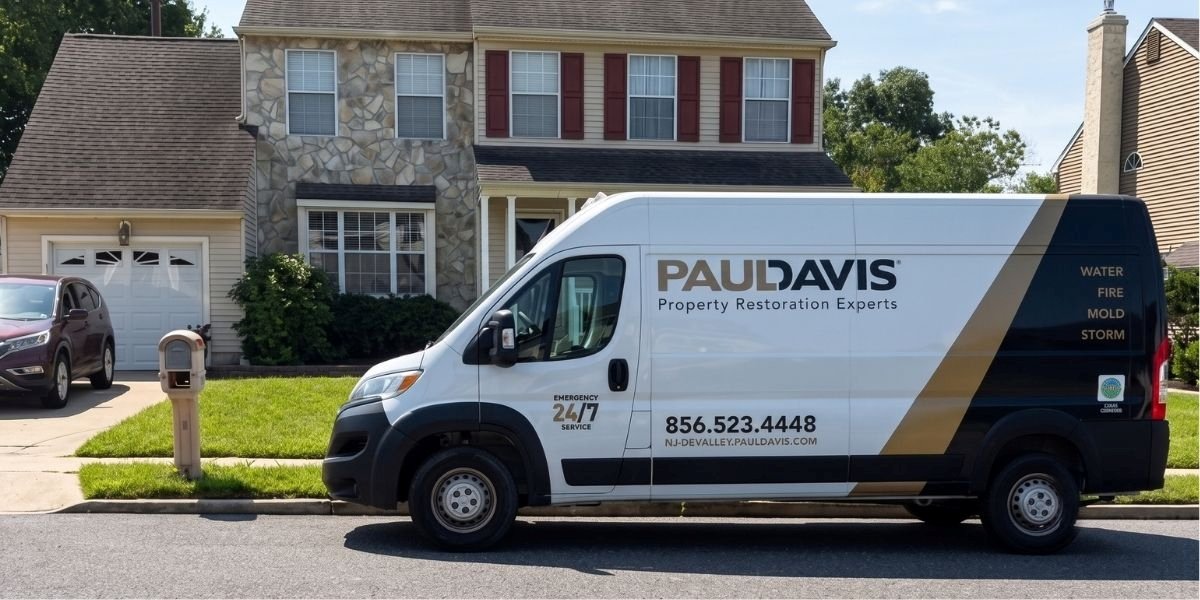
Gloucester, Salem, and Camden Counties are home to a mix of historic houses and small, independently owned businesses, both of which can require a more careful approach to restoration than a standard newer-construction repair. Paul Davis Restoration of NJ Delaware Valley has built its local reputation around that kind of detailed work. The franchise is led by Scott Wenger, whose team blends national restoration resources with a family-run, local commitment to service.

Meticulous Care for Historic Homes and Small Businesses

The company serves both residential and commercial properties across the region, with particular attention to historic homes and small businesses that require careful documentation and coordinated insurance handling. That range extends from single-room water losses to larger commercial disasters, giving the team the flexibility to scale a response to what a property needs.

In Haddonfield, one of the region’s historic districts and the company’s top target market, that scalability can matter especially. Older construction often requires more careful documentation and a gentler touch during mitigation than newer homes. The residential services page outlines how that careful approach carries through a typical homeowner project.

Response Speed Backed by Local Presence

Wenger describes the company’s response commitment directly.

“We respond within 60 to 90 minutes of your call, 24 hours a day, 7 days a week,” he said, adding, “Our local team is strategically based in Gloucester County to reach anywhere in the NJ Delaware Valley territory quickly.”

That local positioning can matter for commercial clients as well, particularly small businesses that may struggle to absorb extended downtime. In Woodbury, home to a mix of retail storefronts and older mixed-use buildings, response speed can influence how much of a business’s inventory and equipment may be preserved after a fire. The commercial services page details how the company supports business clients through a loss.

National Expertise and Local Accountability

Wenger frames the company’s broader approach around a simple idea.

“Our team brings national expertise with a local, family-run commitment to service, quality, and accountability,” he said, describing a concierge-style process that manages a project from emergency mitigation through insurance coordination and full rebuild under one roof.

That end-to-end structure means clients may not have to track down separate contractors for cleanup, repairs, and insurance paperwork. In Glassboro, where mold remediation scope can shift once a wall or ceiling is opened, that single point of accountability gives homeowners one team to work with from the first inspection through the final walkthrough.

What NJ Delaware Valley Clients Are Saying

Recent client feedback consistently points to responsiveness and professionalism. Judy E. said the crew arrived on time, was courteous, and provided thorough explanations for every repair, adding that the home was left tidy after both mitigation and repairs were complete. Crystal C. described feeling calmer throughout a chaotic situation because of the company’s work ethic, compassion, and overall knowledge. Rob W. praised the team’s thoroughness, professionalism, and transparency, joking that five stars felt like too low a rating for the experience.

Frequently Asked Questions

Does Paul Davis Restoration of NJ Delaware Valley work on historic homes?

Yes. The company serves historic homes throughout Gloucester, Salem, and Camden Counties, where older construction can require careful documentation and handling during restoration.

How fast does the company respond to a call?

The team aims to respond within 60 to 90 minutes of a call, 24 hours a day, seven days a week, with a local base in Gloucester County positioned to reach the surrounding territory quickly.

Does the company handle both small residential jobs and large commercial losses?

Yes. Paul Davis Restoration of NJ Delaware Valley scales its response from single-room water losses to larger commercial disasters, serving both homeowners and small businesses.

What areas does Paul Davis Restoration of NJ Delaware Valley serve?

The franchise serves Haddonfield, Sewell, Glassboro, Woodbury, Camden, Mullica Hill, and surrounding communities throughout Gloucester, Salem, and Camden Counties in New Jersey.

Stay Connected With Paul Davis Restoration of NJ Delaware Valley

For project updates and local news, homeowners and businesses can follow Paul Davis Restoration of NJ Delaware Valley on Facebook, Instagram, and LinkedIn.


Anthropic’s $11.5 Billion Quarter Lifts Wall Street as AI Spending Confidence Reaches the NYSE Trading Floor

Anthropic reported preliminary second-quarter revenue exceeding $11.5 billion, a more than 14-fold increase from $787 million in the same period last year, according to documents viewed by Bloomberg News. The company also posted positive adjusted operating income for the first time in its history. By Monday morning, the numbers had moved markets. Nasdaq 100 futures rose 0.52%, outpacing S&P 500 futures by a factor of four, as chipmakers and megacap technology stocks climbed in premarket trading on the New York Stock Exchange.

The quarterly figure more than doubled the $4.73 billion Anthropic recorded in the first quarter of 2026, meaning the Claude chatbot maker generated roughly $16.2 billion in revenue across the first half of the year alone. Reuters separately reported Friday that Anthropic has projected 2028 revenue of approximately $190 billion to $200 billion, according to two people familiar with the company’s financials, a forecast that gave investors additional reason to pile into AI-exposed equities at Monday’s open.

NYSE Premarket Trading Reflected Immediate AI Confidence

The reaction on the trading floor was concentrated in semiconductor and storage stocks. Micron Technology gained more than 3% in premarket trading Monday morning, while Broadcom rose roughly 1.2%. Amazon and Alphabet, both companies with deep commercial ties to Anthropic’s cloud infrastructure, added 1.3% and 0.8% respectively before the opening bell. Nvidia also traded higher.

The S&P 500 itself opened relatively flat, with the broad index trading down 0.1% as Middle East tensions and elevated oil prices near $89 a barrel offset the technology sector’s gains. The Dow Jones Industrial Average shed 169 points, or 0.3%. The divergence between the Nasdaq’s strength and the Dow’s weakness underscored how narrowly the AI revenue story was driving Monday’s session, with growth-oriented investors buying into the thesis that enterprise AI spending will sustain its trajectory while cyclical sectors remained cautious.

Enterprise Adoption Fueled the Revenue Surge

Anthropic’s growth has been built overwhelmingly on business customers rather than consumer subscriptions. Enterprise and API revenue account for approximately 80% of total sales. The company reported in February that the number of customers spending more than $100,000 annually had grown sevenfold over the prior year, and that eight of the ten largest companies in the Fortune 10 were Claude customers. By the time of its $65 billion Series H funding round in May, which valued the company at $965 billion post-money, Anthropic disclosed an annualized revenue run rate exceeding $47 billion.

Claude Code, the company’s agentic coding product launched in May 2025, has become a significant revenue driver on its own. The product reached $2.5 billion in annualized revenue by February 2026, with weekly active users doubling since January. Business subscriptions for the coding tool have quadrupled since the start of the year. Payment data from Ramp showed that as of June 2026, 34.4% of U.S. enterprises were paying for Anthropic services, narrowly surpassing OpenAI’s 32.3% share.

The IPO Pipeline Adds Urgency to the Numbers

Anthropic confidentially filed listing paperwork with the SEC in June and is targeting an October Nasdaq debut with Goldman Sachs, JPMorgan, and Morgan Stanley leading an offering expected to raise more than $60 billion. Chief Financial Officer Krishna Rao has been leading early meetings with prospective investors, though those discussions have reportedly remained high-level, focusing on the company’s Claude model series and market positioning without drilling into specific valuation figures.

The Financial Times reported that investors are targeting a $2 trillion valuation for the IPO, a figure that would place Anthropic among the most valuable companies on earth before it has completed a single full year of profitability. The preliminary positive adjusted operating income posted in the second quarter represents a genuine milestone for a company that raised $125 billion in total funding, but Wall Street analysts have noted that a single profitable quarter does not establish durable margins in an industry where compute costs, model training expenses, and infrastructure buildouts continue to escalate.

The Competitive Landscape Is Tightening

Anthropic’s revenue acceleration is happening alongside similar growth at OpenAI, which has seen enterprise revenue surpass consumer sales for the first time. Both companies are racing toward public listings in an IPO market that has already raised $256.4 billion this year, the highest total since 2021. DeepSeek, the Chinese AI firm that has been gaining market share with aggressively priced models, is also reportedly preparing to file for an IPO as soon as this year.

The competition between the three firms has intensified on pricing. OpenAI released updated models that improve agent-based coding efficiency by 54% while cutting API prices for developers. Anthropic has responded by expanding its model lineup across price tiers, with Claude Haiku 4.5 targeting cost-conscious enterprise users at roughly one-third the price of the mid-tier Claude Sonnet while maintaining comparable performance on key benchmarks.

For investors watching Monday’s trading session on the NYSE floor, the Anthropic numbers crystallized a question that has defined Wall Street’s AI thesis throughout 2026. The revenue is real, the growth rate is extraordinary, and the enterprise adoption curve shows no signs of flattening. Whether that trajectory justifies the valuations being attached to AI companies, both public and pre-IPO, is the open question that will determine how the rest of the year trades.

Disclaimer: This article is provided for informational and educational purposes only and should not be considered financial, investment, trading, or legal advice. The information presented about Anthropic, its reported revenue, potential IPO, valuation, financial performance, and the impact on publicly traded companies is based on preliminary figures and reports from third-party sources and may change as additional information becomes available. Market movements and company valuations can be affected by numerous factors, including economic conditions, geopolitical developments, investor sentiment, corporate announcements, and changes in the artificial intelligence sector. Past or reported market performance does not guarantee future results. Readers should conduct their own research and consult a qualified financial professional before making investment decisions. The publication does not recommend buying, selling, or holding any security or financial instrument discussed in this article.

FAQs

How much revenue did Anthropic report for Q2 2026?

Anthropic reported preliminary second-quarter revenue exceeding $11.5 billion, up from $787 million in the same quarter of 2025 and $4.73 billion in the first quarter of 2026. The company also posted its first-ever positive adjusted operating income.

When is Anthropic’s IPO expected?

Anthropic confidentially filed with the SEC in June 2026 and is targeting an October Nasdaq listing. Goldman Sachs, JPMorgan, and Morgan Stanley are leading the offering, which is expected to raise more than $60 billion.

How did Anthropic’s revenue report affect the stock market?

Nasdaq 100 futures rose 0.52% Monday morning, with chipmakers Micron Technology gaining over 3% and Broadcom rising 1.2% in premarket trading. Amazon and Alphabet also climbed on the strength of the AI spending outlook.